
NIKLAS Test Field
Test station to DIN EN 50191 for high-voltage testing and EOL testing
With the NIKLAS Test Field you test control cabinets, machines and assemblies for high voltage, insulation and protective conductor at a test station to DIN EN 50191, also at the end of production. We plan the set-up and test sequence around your test item.

Test station to DIN EN 50191
A high-voltage test can be carried out safely if the test station protects against contact, residual voltage and operating errors. That is why we plan the test station to DIN EN 50191.
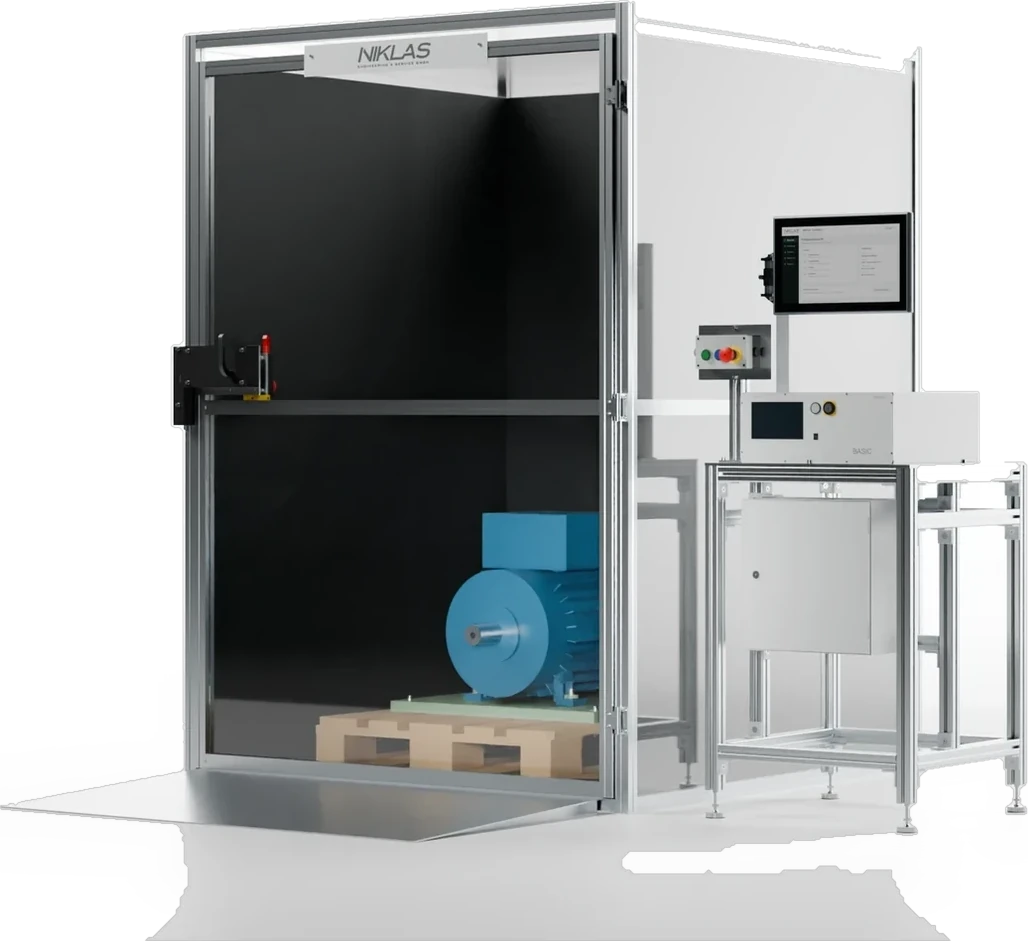
In sizes S and M, the Test Field is a closed test box. In size L it becomes a walk-in test cell that you load via a ramp, for example for control cabinets or motors on pallets.
- Safe test areaTesting only with the guard closed
- After the testDischarging or earthing before opening
- Test recordMeasured values for each test item in the test report
At a glance
Control cabinets, machines, assemblies
High voltage, insulation, protective conductor
DIN EN 50191 (VDE 0104)
Interlocked test area, emergency stop
Measured values for each test item
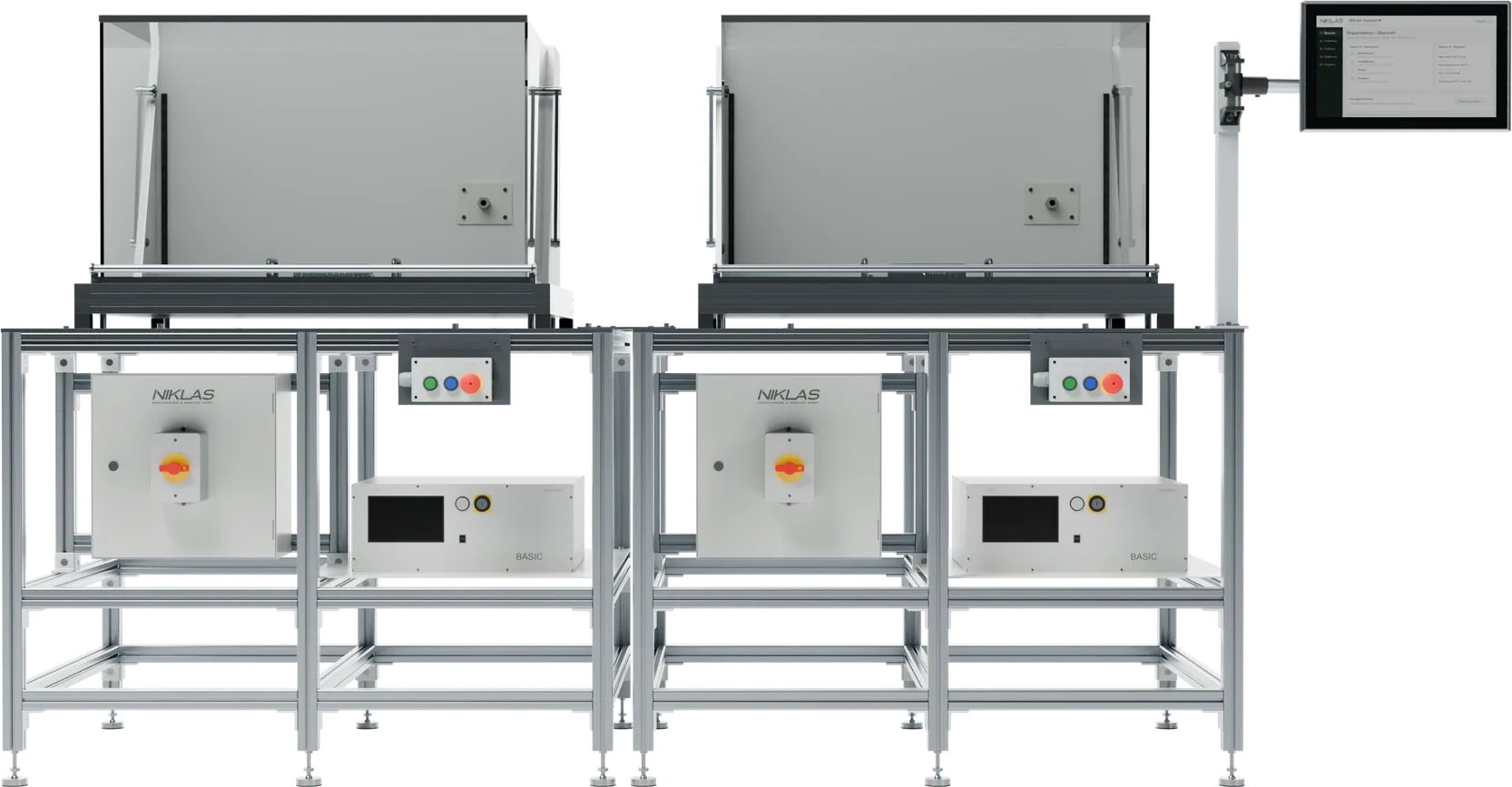
S and M as a test box, L walk-in, or to custom dimensions
Set-up and test scope depend on the test item and test specification. Sizes S, M and L are guide values, and we also build to custom dimensions.
What the test station delivers technically
We plan and build the test station around your test items: set-up, safety technology, test item fixture and software. We integrate the high-voltage tester into the sequence.
Interlocked test area
Testing only with the guard closed, opening only after switch-off.
Emergency stop
Emergency stop for the test area.
Switching states
Display of the switching states at the test station.
Discharging and earthing
Discharging or earthing of the test item after the test.
Test item fixture
Fixture with contacting for your control cabinets, machines or assemblies.
High-voltage tester
We integrate the hipot tester into the test sequence, and the software controls it.
Test sequence
Implement the test voltage, sequence and limit values from your product standard or test specification.
Measured values
Record the measured values for each test item in the test report.
High-voltage testing to DIN EN 50191: standard, safety, EOL
When the standard applies, which safety devices a test station needs, what the safety test measures and what to consider at the end of production.
When DIN EN 50191 applies
The standard applies to test installations where touching live parts is dangerous. Whether this applies to your test is decided by voltage, current and discharge energy.
Touching is considered dangerous from 25 V AC or 60 V DC up to 500 Hz, from 3 mA AC or 12 mA DC, or from 350 mJ discharge energy. Below these values, risks such as the energy of a capacitor must also be assessed.
High-voltage testers that limit the test current to 3 mA stay below the current threshold. Whether the standard still applies to your test station, for example for a functional test at mains voltage, is clarified by the workplace risk assessment.
A test station is spatially limited and marked, and usually one person works there. A test field is an enclosed or delimited area for larger test objects and several people. Experimental fields are used for research and development.
The relevant edition is DIN EN 50191 (VDE 0104), edition 2011-10. We base our work on the edition valid at the time of the order.
Safety devices at the test station
Test stations with positive protection against contact switch off via interlocking and covers. Open test stations also need demarcation, emergency stop and signal lamps.
If someone opens the protective device, the test voltage must switch off positively, and residual voltage must first drop to a safe value. A single fault must not prevent switch-off. It must not be easy to bypass the protective device.
Open test stations need signal lamps that indicate the states ready to switch on and in operation. Indicator lamps at the control station show the switching state and do not replace the signal lamps. The standard governs colours and assignment.
Test stations without positive protection against contact need emergency stop devices that switch off all hazardous energies. At least one control device is located outside the test area.
After the test, there must be no dangerous voltage on accessible parts. Earthing, short-circuiting or discharge circuits with guard locking are used for this. An earthing bar that only drops under its own weight is not considered safe earthing.
What the safety test measures
The safety test consists of the protective conductor, insulation and voltage tests. Your product standard or test specification defines the limit values, test voltage and sequence, and we implement them in the test sequence.
The resistance between the protective conductor terminal and all accessible conductive parts is measured. According to EN 60204-1, the value must match the length, cross-section and material of the protective conductor, and the limit used belongs in the report.
The insulation measurement applies 500 V DC, and EN 60204-1 requires at least 1 MΩ. It shows the condition of the insulation at low voltage. Only the high-voltage test checks the dielectric strength of the insulation.
The high-voltage test applies AC voltage between the short-circuited conductors of the main circuit and the protective conductor. According to EN 60204-1, twice the rated supply voltage applies, but at least 1000 V, for at least 1 s. The test is passed if there is no breakdown.
The high-voltage tester monitors the current. If it exceeds the set limit, the test is considered failed. Test items with interference suppression capacitors draw more current by design, and the limit must take this into account.
Testing at the end of production
The EOL test follows the product standard and applies to each test item individually. Its result belongs in the report for each serial number.
Type tests are carried out once on a sample, routine tests on every finished unit. They are intended to reveal unacceptable deviations in materials or in production. The product standard states which tests are included.
EN 60204-1 applies to machines and control cabinets; for other products, the product standard states the test scope. Your test specification, which you derive from the product standard, is binding. We implement the scope and limit values accordingly.
A sound report states the test item identification, date, measured values with limit values, test equipment with proof of calibration and the overall result. In the Test Field, the serial number, test date and measured values for each test item are in the test report. Our Knowledge article explains the structure and content of a test report to EN 60204-1.
Products that passed and faulty products must be clearly distinguishable, for example by a sticker, rating plate or rejection from the line. After a repair, we recommend repeating the complete safety test.
Which test station suits your test items?
Tell us the test items, test voltages and quantity. We tell you which design and which safety technology suit them.
Which design suits your test item
DIN EN 50191 distinguishes between test stations with and without positive protection against contact. We derive the design your test task requires from the risk assessment and specify it in the quotation. You will find a checklist for the test station in our Knowledge section.

The test item and all active parts are behind a fixed cover with at least protection class IP3X. A test pin of 2.5 mm diameter must not be able to penetrate. Opening switches off the test voltage.
Walls from 1800 mm high or grilles with a mesh size of no more than 40 mm delimit the test area. The door can only be opened when the installation is off, secured against being switched on again and earthed if necessary.
Without positive protection against contact, it is only permitted if the closed design cannot be used, for example with frequently changing test tasks. It needs demarcation, emergency stop, signal lamps and a second person with visual and audible contact.
Safety test probes and two-hand control occupy the tester's hands and protect only the tester. The standard governs when test probes are permitted, depending on the test voltage and leakage current.
EOL test station for testing at the end of production
An EOL test station tests every product at the end of production before it leaves the plant. For this, our Test Field combines the safety test to DIN EN 50191 with a functional test and records the result for each serial number.
Safety test
High-voltage, insulation and protective conductor testing run at the same station, in the interlocked test area to DIN EN 50191.
Functional test
The functional test of the test item is added to the safety test. Scope and limit values depend on your test specification.
Test report for each serial number
The serial number, test date and measured values for each test item are in the test report.
Connection to MES and ERP
We clarify the connection to your MES, ERP or test data system in advance.
Test software with test report
The software controls the hipot tester and records the measured values for each test item in the test report. The operators work through the stored test sequence.
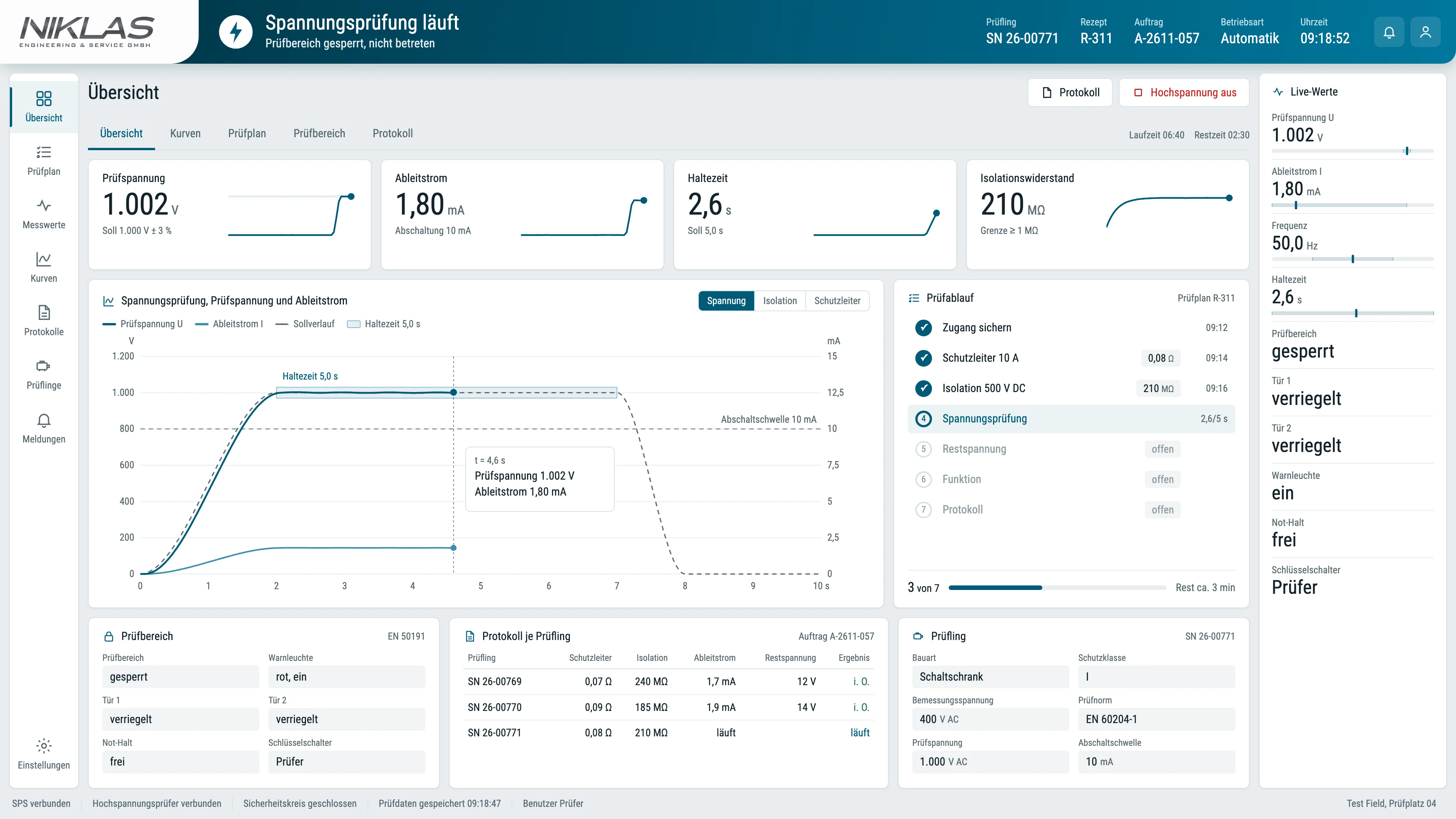
Concept view of the test software. Range of functions depending on the configuration.
For operators at the test station
Test voltage, sequence and limit values according to your test specification.
Results are stored assigned to the test item.
We clarify the report format and the connection to ERP or a test data system in advance.
Frequently asked questions about the test station to DIN EN 50191
Here we answer what operators need to know before enquiring about a test station. Test voltage and test scope are specified by your standards and product specifications.
What is the difference between insulation measurement and high-voltage testing?
The insulation measurement determines the resistance with DC voltage, while the high-voltage test stresses the insulation with high voltage and checks whether it withstands it. Neither flashover nor breakdown may occur.
Who may test at a test station to DIN EN 50191?
Qualified electricians and electrically instructed persons, after they have been instructed in the safety requirements and operating instructions. We instruct your staff on the installation; operating instructions and regular instruction are among your tasks as the operator.
How often must the safety devices of a test station be inspected?
At appropriate intervals by a qualified electrician, with documentation. You set the interval according to the workplace risk assessment; at least once a year is a proven guide value.
How do I test control cabinets with frequency converters during the high-voltage test?
Disconnect components that cannot withstand the test voltage beforehand, for example electronics and EMC components in the frequency converter, or treat them according to the manufacturer's instructions. A test plan records which contactors are active and where the voltage is applied.
How quickly must the residual voltage drop after switch-off?
According to EN 60204-1, voltages above 60 V must drop to 60 V or less within 5 s. Components with a stored charge of no more than 60 µC are exempt, and 1 s applies to plugs with exposed pins.
Which standard applies to testing after modification or repair?
EN 60204-1 applies to machines; its chapter 18.7 governs retesting after changes. Recurring inspections of electrical installations and equipment are governed in Germany by DGUV V3, the accident prevention regulation for electrical installations and equipment; more on this on our page DGUV V3 inspection.
What is an EOL test station?
EOL stands for end of line, the last test station in production, where every product is tested before delivery. With the Test Field, the safety test and functional test belong together, and the serial number, test date and measured values for each test item are in the test report.
What information helps for a quotation?
Type, dimensions and weight of the test item, test voltage or power, the tests you require, tests per day, the standards you test to and the installation site with mains connection. Rough information or a photo with the rating plate is enough, and we ask about anything missing.
Discuss a test station for your test task
Describe the test item, test voltage and quantity. We are also happy to discuss unusual test items. We get back to you with a proposal for the set-up and sequence.

Simon Niklas
Mechanical engineer, M.Sc.
+49 941 56956720[email protected]
“Good engineering proves itself in day-to-day production. That is why we combine technical planning with a close understanding of process, operation and maintenance.”
Book a consultation