
 Test engineering
Test station to DIN EN 50191 (VDE 0104): checklist for setup, safety technology and operation
A test station to DIN EN 50191 (VDE 0104) must protect people from touching live parts. Priority goes to the test station with automatic protection against direct contact, that is a test box or an interlocked cabin; an open test station is only permitted with a justification and needs a barrier, emergency stop, red signal lamps and a second person. On top of this come safe discharge, marking, instructed staff and safety devices whose testing is documented.

When does DIN EN 50191 apply to a test station?
DIN EN 50191 (VDE 0104) applies to the erection and operation of electrical test facilities where touching live parts is dangerous. DGUV Information 203-034, the guidance of the German Social Accident Insurance on this standard, gives the thresholds as voltages above 25 V AC or 60 V DC (up to 500 Hz), currents above 3 mA AC or 12 mA DC and a discharge energy above 350 mJ. Risks such as arcs on batteries or charged capacitors must also be assessed below these values.
The relevant edition is DIN EN 50191 (VDE 0104):2011-10. DGUV Information 203-034 explains the standard for practical use, but still refers to the 2001 edition. Where the two differ, the current text of the standard applies.
The standard distinguishes four types of test facility:
- Test station: spatially limited and marked, usually with one person working there. It exists with and without automatic protection against direct contact.
- Test area: an enclosed or fenced-off area in which several people test larger test objects over a longer period.
- Experimental area: a test facility for research and development, usually without routine tests.
- Non-stationary test facility: set up for a short time, for example to test installed cables.
The energy in the test item is often overlooked. Control cabinets with interference suppression filters, long cables and motor windings form capacitances to earth. After a DC voltage test they store energy that can exceed the 350 mJ limit.
W = 12 · C · U2
- W
- stored energy in J (1 J = 1,000 mJ)
- C
- capacitance of the test item to earth in F
- U
- voltage to which the test item is charged, in V
Example: A control cabinet with 0.47 µF to the protective conductor, tested at 1,500 V DC, stores ½ · 0.47 µF · (1,500 V)² = 0.53 J, or around 530 mJ. That is above 350 mJ. At 1,500 V the limit is already exceeded from about 0.31 µF (example values).
The DGUV Information shows a high-voltage tester that is operated with a current limit of 3 mA and therefore works without connected signal lamps. Whether your setup can be classified in this way is decided by your workplace risk assessment. The current limit does not limit the energy stored in the test item.
Test station with or without automatic protection against direct contact: what is the difference?
At a test station with automatic protection against direct contact, the test item and all active parts are fully protected against direct contact while switched on. At a test station without automatic protection against direct contact, parts are openly accessible during the test. The protected design has priority; the open design is only permitted if the protected one cannot be used, for example with frequently changing test tasks or test objects.
| Feature | With automatic protection against direct contact | Without automatic protection against direct contact |
|---|---|---|
| Design | Closed test box at least IP3X, or walk-in cabin with solid walls from 1,800 mm high or mesh with up to 40 mm mesh size | Open station, protection by insulation, covers, safe distances, two-hand control or safety test probes |
| Disconnection | Opening automatically switches off the test voltage, a single fault must not prevent this | Emergency stop for all hazardous energies, at least one control device outside the test area |
| Barrier | No additional barrier required | Towards workplaces and traffic routes, with a line of sight from outside |
| Signal lamps | Not required, often useful with high voltage | At least red for "Ready to switch on" and "In operation" |
| Additional protection | According to the workplace risk assessment | RCD with at most 30 mA if the test circuit is galvanically connected to the mains |
| Staff | Management and supervision by a qualified electrician are not needed with IP3X and high-grade safety technology | Second person within sight and hearing as long as the station is ready to switch on or in operation |
IP3X means that an access probe with a diameter of 2.5 mm must not enter. In a walk-in cabin, the door can only be opened once the installation is switched off, secured against being switched on again and, if necessary, earthed and short-circuited. Everyone must have left the cabin before it is switched on.
For the control of the interlock, the DGUV Information derives category 3 of the former EN 954-1 from the required single-fault safety and recommends category 4. Today you assess the safety function to DIN EN ISO 13849-1. If you choose the open design, put the justification in writing; the DGUV Information expressly recommends this, also to protect you in terms of liability.
What must a test station to DIN EN 50191 include?
A test station needs a defined test area, effective protection against direct contact, disconnection via interlock or emergency stop, marking, fault protection, safe discharge and organisational records. The following checklist summarises the points from the standard and the DGUV Information. It replaces neither the text of the standard nor your workplace risk assessment.
| Check item | Requirement | How to check it |
|---|---|---|
| Design | Automatic protection against direct contact or a justified exception | Written justification available |
| Cover, cabin | IP3X, or walls from 1,800 mm and mesh up to 40 mm | Measure height and mesh size, check gaps |
| Interlock | Opening switches off, residual voltage has dissipated before access | Open the test box with voltage applied, check the guard locking on the cabin, check disconnection |
| Emergency stop | Switches off all hazardous energies, one control device outside | Operate every control device |
| Signal lamps | Red, green also recommended, visible beyond the test area | Visible from every access point? |
| Marking | Electrical voltage warning sign, above 1 kV additional sign "High voltage: danger to life" | Signs at all access points |
| Barrier | Conductive parts earthed or included in the fault protection | Measure the protective conductor connection |
| Fault protection | RCD at most 30 mA with galvanic mains connection, suitable type for DC fault currents | Trip the RCD, check the type |
| Workplace | Non-conductive table top, touch-protected test leads, at least 1.5 m² of movement area and 1 m width | Visual inspection, measure |
| Discharge | Earthing, short-circuiting or discharge circuit, above 1 kV earthing devices | Measure the residual voltage after the test |
| Organisation | Operating instructions, record of instruction, test record of the safety devices | Documents at the station and up to date |
Go through the list at the station, not at your desk. Trigger the emergency stop and the door contact with the test voltage applied and watch the tester to see whether the voltage switches off. Then measure on the test item whether the residual voltage has dissipated. Mark electrical connection points that are not switched off by the emergency stop separately.
Which signal lamps and operating states does a test station need?
A test station without automatic protection against direct contact needs at least red signal lamps for the states "Ready to switch on" and "In operation". The DGUV Information recommends green signal lamps for "Ready for operation". In test areas above 1 kV, red and green signal lamps are mandatory.
Signal lamps are clearly visible beyond the boundaries of the test area and show the operating state to everyone nearby. Indicator lamps on the control desk, by contrast, only show the switching state and do not replace a signal lamp. The four operating states, using a stationary test facility above 1 kV as an example:
| State | Access points | Signal lamp | Control circuits | Test voltage | Earthing |
|---|---|---|---|---|---|
| Out of operation | open | off | off, secured | off, secured | yes |
| Ready for operation | open | green | on | off | yes |
| Ready to switch on | closed | red | on | off | no |
| In operation | closed | red | on | on | no |
In practice, a traffic light with fixed logic in the safety controller has proven itself: red lights up as soon as the access points are closed and the earthing is removed, and not just when the test voltage is switched on. A defective red lamp should block switching on, otherwise the station shows "safe" in the event of a fault. Whenever you leave the station, always set the "Out of operation" state.
Which safety distances and barriers apply at the test station?
The danger zone is the area around live parts that nobody may reach as long as there is no complete protection against direct contact. Up to 1,000 V, the surface of the part itself is the limit. Above that, the danger zone grows with the test voltage, and merely reaching it counts as contact.
The DGUV Information reproduces the tables from Annex A of the standard (2000 edition). An extract for AC test voltage 50/60 Hz, RMS value to earth:
| AC test voltage | up to 1 kV | 3 kV | 5 kV | 10 kV | 20 kV | 50 kV | 100 kV |
|---|---|---|---|---|---|---|---|
| Danger zone s | no contact | 20 mm | 30 mm | 60 mm | 115 mm | 280 mm | 560 mm |
For DC test voltage the distances are the same as for lightning impulse voltage, so at least 100 mm from 20 kV. Intermediate values may be interpolated, but the table must not be extrapolated beyond the largest value.
If the barrier has openings, a minimum distance from the opening to the danger zone is added. For square openings, Table A.4 gives 120 mm for widths over 12 to 30 mm, 200 mm for over 30 to 40 mm and 850 mm for over 40 to 120 mm. The values are larger for slots.
amin = s + c
- amin
- minimum distance from the live part to the barrier in mm
- s
- danger zone according to Table A.2 in mm
- c
- minimum distance from the opening to the danger zone according to Table A.4 in mm
Example: At 5 kV AC test voltage, s = 30 mm. A mesh with 40 mm mesh size needs c = 200 mm. The mesh must therefore be at least 230 mm away from the live part (example values).
For low barriers without openings, Table A.3 determines the horizontal distance from the height of the barrier and the height of the danger point. In test areas above 1 kV, mesh or solid walls from 1,800 mm are mandatory; up to 1,000 V, ropes, chains or rails at a height of about 1,000 mm are sufficient. Check the values against the current edition of the standard before you build to them.
How long does it take to discharge a test item after the high-voltage test?
A test item discharges exponentially through the resistance it is connected to. Through a discharge resistor this takes fractions of a second, through its own insulation resistance often many minutes. This is why it is actively discharged and earthed after every test before anyone touches the test item.
U(t) = U0 · e−t / (R · C) and t = R · C · ln U0UG
- U(t)
- residual voltage at time t in V
- U0
- voltage at switch-off, i.e. the test voltage, in V
- UG
- permissible residual voltage, for example 60 V, in V
- R
- resistance of the discharge path in Ω
- C
- capacitance of the test item in F
- t
- time after switch-off in s
Example: The control cabinet with 0.47 µF was tested at 1,500 V DC. Through a discharge resistor of 100 kΩ the time constant is 0.047 s, and the voltage is below 60 V after 0.047 s · ln(1,500 / 60) = 0.15 s. Without a discharge circuit it discharges only through its insulation resistance of, for example, 2 GΩ: the time constant is then 940 s, and it only drops below 60 V after around 50 minutes (example values).
This leads to three rules for the station:
- Discharging is part of the test: the interlock only releases once the residual voltage has dissipated. The standard requires this for test stations with automatic protection against direct contact.
- Earthing must be effective: according to the DGUV Information, an earthing bar that merely drops onto the earth contact by its own weight at switch-off does not count as safely effective earthing.
- Watch out for recharging: long cables and windings can build up voltage again after a brief discharge, because the insulating material discharges with a delay. Keep such test items earthed until you disconnect them.
In AC voltage tests the residual voltage is usually lower, because the voltage is not always at its peak value at switch-off. Do not rely on this: measure the residual voltage before you release the test item.
When are safety test probes permitted at the test station?
Safety test probes and two-hand controls keep the tester's hands occupied and protect only the tester, not other people. According to the DGUV Information, testers with safety test probes must not be used on test objects whose leakage current on the high-voltage side exceeds 3 mA. In that case you test with fixed connections in the interlocked test station.
This leakage current is driven mainly by capacitances to earth. For an AC voltage test, you can estimate it in advance as follows:
I = 2π · f · C · U
- I
- capacitive current to earth in A
- f
- frequency of the test voltage in Hz
- C
- capacitance between test setup and earth in F
- U
- test voltage (RMS value) in V
Example: At 1,500 V and 50 Hz, a capacitance of 10 nF already gives 2π · 50 Hz · 10 nF · 1,500 V = 4.7 mA, which is more than 3 mA. With these values the limit is already reached at about 6.4 nF (example values). Interference suppression capacitors to the protective conductor often have more.
According to the DGUV Information, this leakage current is measured with an ammeter that simulates the tester with an internal resistance of 2,000 Ω. The same relationship explains why test items with filters trip during the hipot test even though the insulation is fine: the trip current of the tester must match the capacitive current.
Further rules from the DGUV Information: above 1 kV, the high-voltage side is galvanically isolated from the mains and insulated from earth, including the test probes. If a second person operates the voltage regulator, they need their own protection against direct contact. Test probes and leads are inspected before every start of work. Two-hand controls must meet requirement level II or III B of the two-hand control standard, today DIN EN ISO 13851. The 2011 edition of the standard added further requirements for safety test probes in section 4.7.
Who may test at the test station and how often is instruction given?
Only qualified electricians or electrically instructed persons work in test facilities. They are instructed before they start the work, and according to DIN EN 50191:2011 the instruction is repeated at intervals of one year. The instruction is documented in writing.
- Management and supervision: test facilities are operated under the management and supervision of a qualified electrician. This does not mean constant presence; the qualified electrician decides the degree of supervision. According to the DGUV Information, this supervision is not required for test stations with IP3X and high-grade safety technology.
- Test areas: there, the staff work under the supervision of a person responsible for the work, who checks on site before switching on that all measures have been taken.
- Access: other people only enter the test facility if they have been adequately instructed or are accompanied by a qualified electrician, above 1 kV with the consent of the person responsible for the work.
- Second person: at an open test station they may do other tasks at the same time, but must be able to recognise hazards immediately and operate the emergency stop.
A qualified electrician tests the safety devices at appropriate intervals and documents this. The DGUV Information gives at least once a year as established practice; you set the specific interval in the workplace risk assessment. A checklist records the item, the tester, the date and the result. In addition, the operator checks for visible damage before every use. The inspection sticker is only applied once the defects have been rectified.
Set up a test station yourself or buy it ready-made?
For occasional tests with changing test items, many companies set up an open test station themselves. For series tests at the end of production, a test station with automatic protection against direct contact is the better choice: the operator only inserts the test item and starts, while the installation takes care of the interlock, discharge and report.
If you build it yourself, you take on the design, risk assessment, safety controller and the verification of the safety functions. What determines the effort, regardless of who builds it:
- Test item: dimensions, weight and access decide between a test box and a walk-in cabin.
- Test voltage: above 1 kV, danger zones, earthing devices and stricter barriers are added.
- Tests: protective conductor, insulation, high voltage and a functional test at mains voltage each need their own measuring paths.
- Contacting: the number of test points and adapters per test item type are often the largest single cost item.
- Throughput: the number of tests per day determines how far the sequence and report are automated.
- Data: report per serial number and connection to MES or ERP.
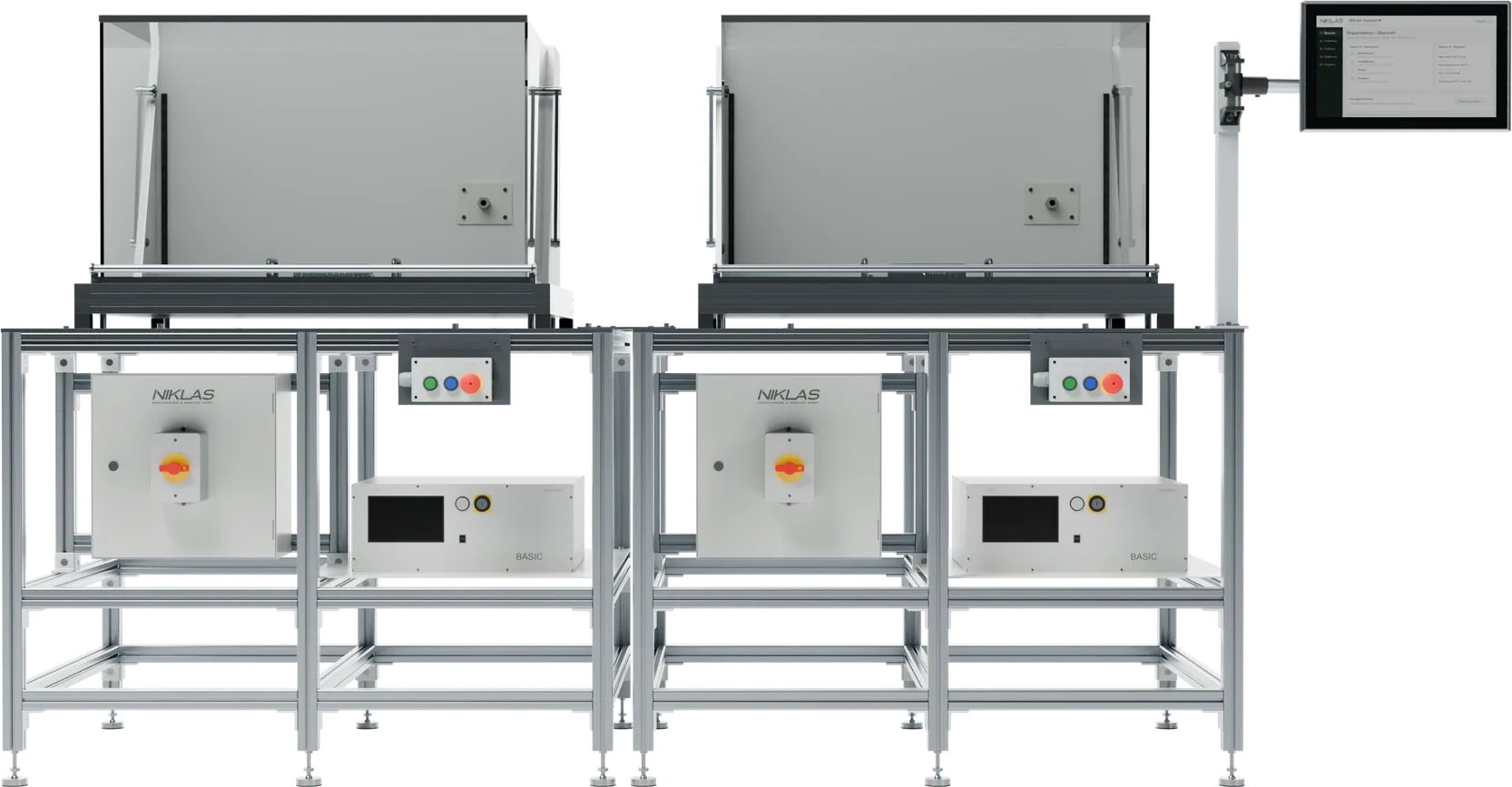
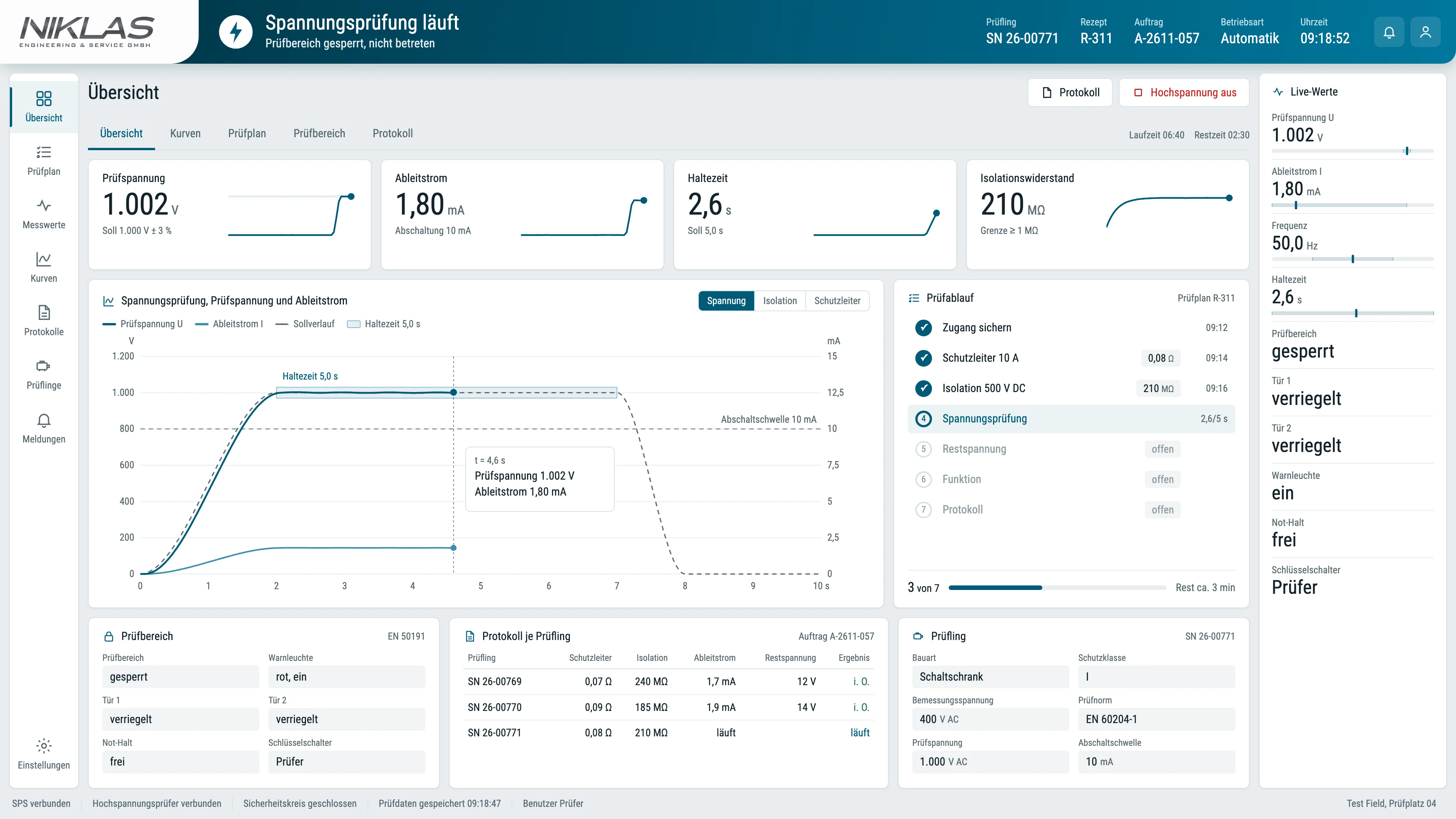
Our NIKLAS Test Field is a test station to DIN EN 50191 with an interlocked test area, emergency stop, discharge or earthing of the test item and display of the switching states, in sizes S, M and L or made to measure. The NIKLAS Test Software controls the high-voltage tester and records the measured values for each test item in the test report. NIKLAS Safety One is coming in 2027: a safety tester for high voltage, insulation and protective conductor that only allows opening and reconnecting once the residual voltage has dissipated.
For a quotation we need the type, dimensions and weight of the test item, the test voltage, the tests you want, the number of tests per day, the standards you test to and the installation site with its mains connection. Rough details or a photo of the rating plate are enough. We carry out the periodic inspection of existing test facilities as part of the DGUV V3 inspection, the inspection of electrical equipment required in Germany. If you build a test station into a machine yourself, clarify conformity in advance; you can find more on this under CE marking.
Frequently asked questions about test stations to DIN EN 50191
Answers to questions that test area managers, quality managers and maintenance staff ask before modifying or buying a test station. The text of the standard and the workplace risk assessment remain authoritative.
What is a test station to DIN EN 50191?
A test station is a spatially limited and marked test facility in which usually one person works. The standard distinguishes test stations with and without automatic protection against direct contact. The protected design with a test box or interlocked cabin has priority.
May a test station be operated without protection against direct contact?
Yes, but only if the protected design cannot be used, for example with frequently changing test tasks or only occasional tests. Then a barrier, an emergency stop with a control device outside, red signal lamps, marking and a second person within sight and hearing are required. Put the justification in writing.
How often must the safety devices of a test station be tested?
At appropriate intervals by a qualified electrician, with documentation. The DGUV Information gives at least once a year as established practice. You set the binding interval in your workplace risk assessment.
How often must the test staff be instructed?
Before they start the work and then, according to DIN EN 50191:2011, at intervals of one year. The instruction is documented in writing. Special instruction is given on the hazards of working with safety test probes.
What determines the cost of a test station to DIN EN 50191?
Mainly the size and weight of the test item, the test voltage, the design, the number of test points and adapters, the degree of automation and the data connection. We give a price in the quotation once we know the test item and the test task. A photo of the rating plate and the test voltage are enough for the first step.
Can an existing test station be retrofitted?
Often, yes. Typical retrofits are a barrier, door interlock, signal lamps, emergency stop and a discharge device. We look at the station on site, record the gaps and name the retrofits. You then decide whether the modification is worthwhile or a new station makes more sense.
Can test results be transferred to MES or ERP?
Yes. With the Test Field, we clarify the connection to your MES, ERP or test data system in advance. Safety One exports results as CSV, JSON or PDF and passes them on to your systems via an API.
Do you train our staff at the test station?
Yes. We train your staff on the installation. The operating instructions and the annual instruction remain the responsibility of the operator; you can use the content of our training for this.
More technical articles
Test engineering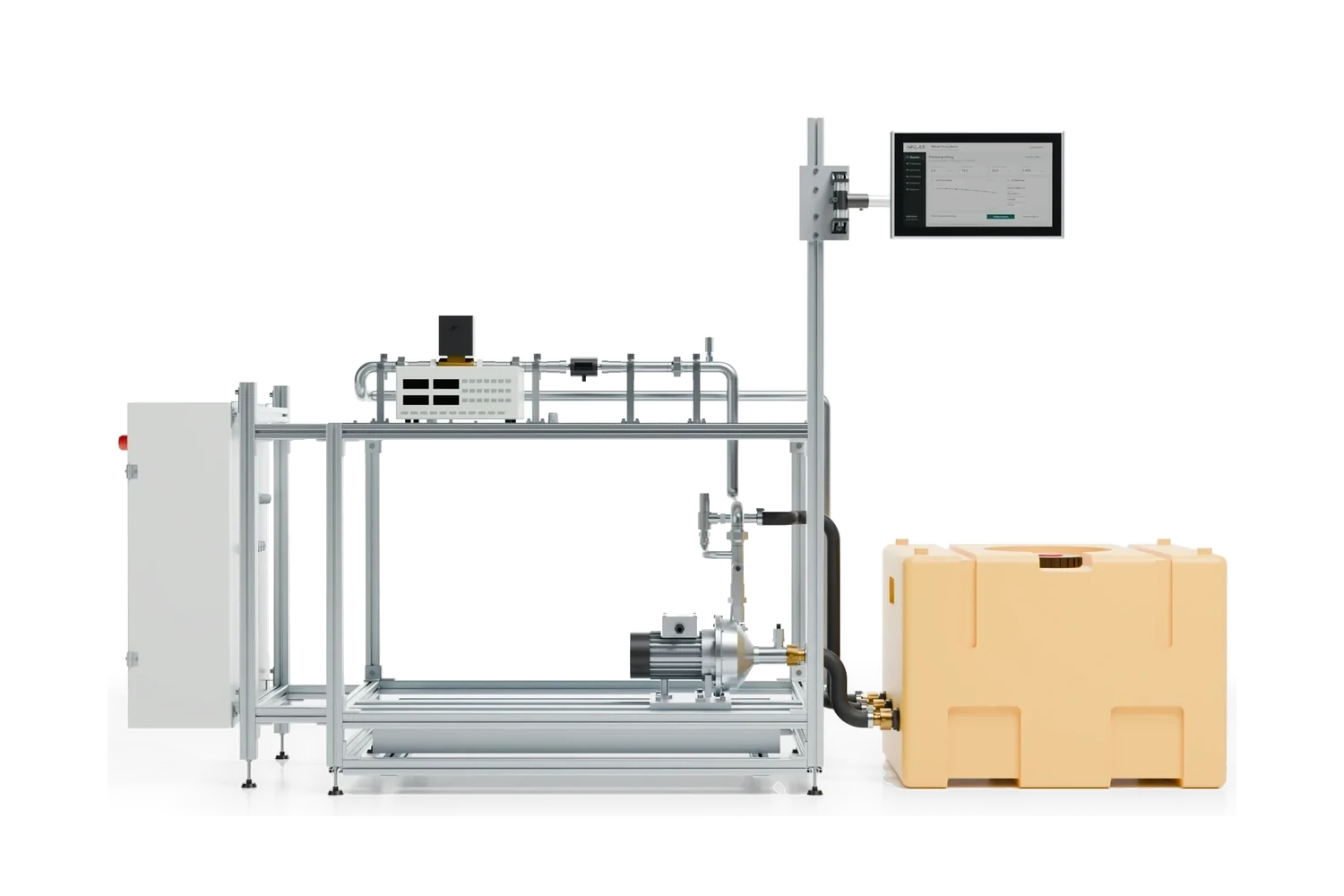 Test engineering
Pump testing ISO 9906
Tolerances of grades 1B, 2B and 3B, head and efficiency with a worked example, measurement uncertainty, NPSH3 and test procedure: how a pump test to DIN EN ISO 9906 runs on the test bench. Test engineering
Test bench requirements specification
Test items, power, measurement uncertainty, cycle time, energy and acceptance with formulas and worked examples: what a requirements specification for a test bench must contain.Request a test station check or Test Field
Send us a photo or sketch of your test station, the test objects and the test voltage. We get back to you personally within 4 working hours with a proposal for scope and date.
Simon Niklas
Mechanical engineer, M.Sc.
+49 941 56956720[email protected]
“Good engineering proves itself in day-to-day production. That is why we combine technical planning with a close understanding of process, operation and maintenance.”
Book a consultation