
CE and machine safety
Risk assessment and workplace risk assessment for machines
We prepare the risk assessment for machine manufacturers to DIN EN ISO 12100 and the workplace risk assessment for operators under the German Industrial Safety Regulation (BetrSichV). You receive a document for the technical documentation or for your operational documentation.
Risk assessment to DIN EN ISO 12100: common gaps
The Machinery Directive and the Machinery Regulation require the manufacturer to carry out a risk assessment. Gaps usually arise in the limits of the machine, in the risk estimation and in the order of the protective measures.
Defining use, misuse and life phases
The assessment starts with the limits of the machine: intended use, reasonably foreseeable misuse and all life phases. With these limits, hazards can be identified completely.
Recording severity and probability for each hazard
Risk is the combination of the severity of harm and the probability of its occurrence. If you record both for each hazard, you can justify the estimate later.
Choosing protective measures in the right order
First the design eliminates the hazard, then come protective devices, and finally information. Where a protective device is technically possible, it takes precedence over a warning sign.
Selected customers

















Machines and installations we assess
Risk assessment and workplace risk assessment depend on the machine and its use. We assess these groups of installations:
Machines for manufacturing, forming, machining and processing parts or materials.
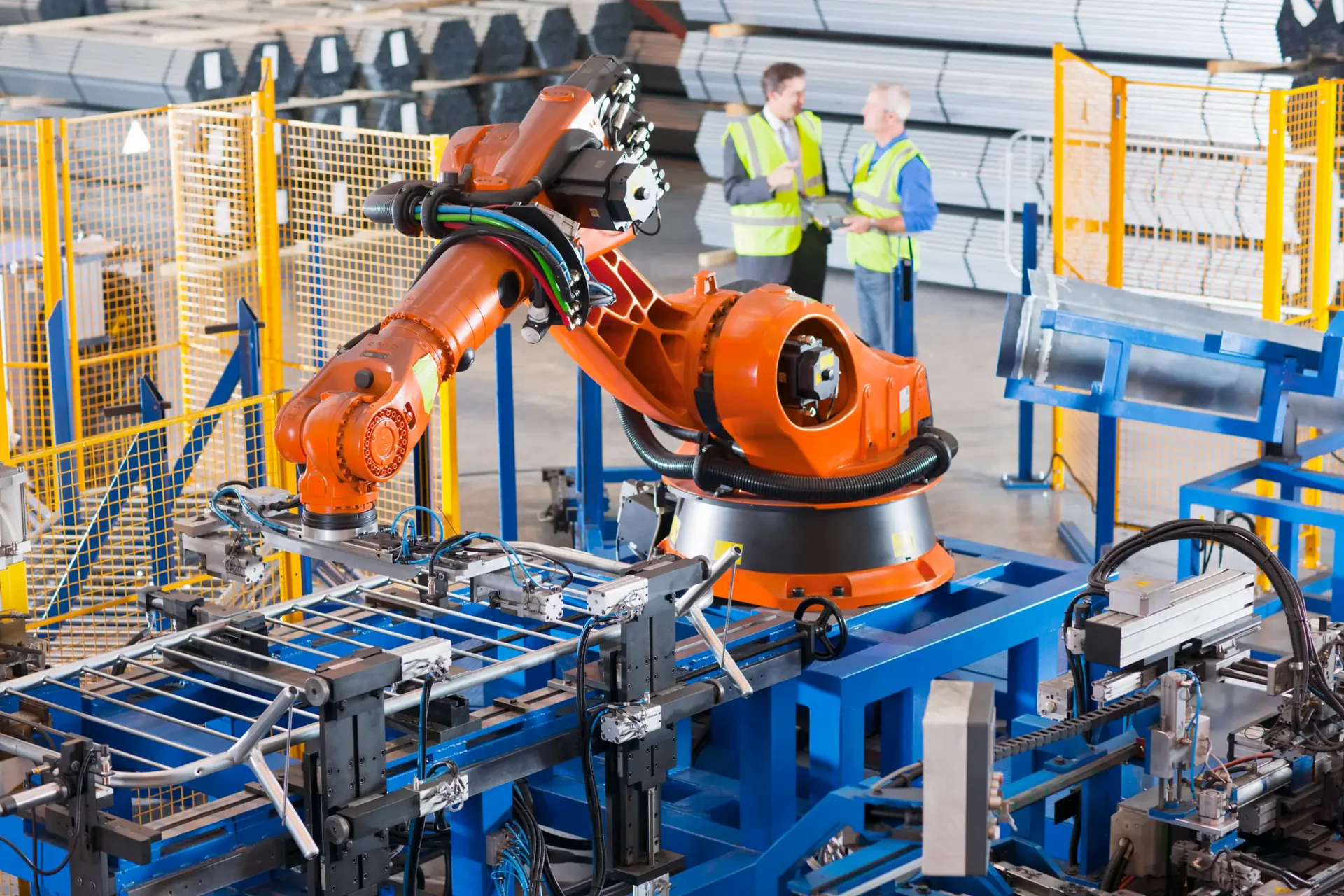
Assembly stations, robot cells and systems for feeding, joining or positioning.
Systems for material transport, sorting, product guidance and packaging.
Test benches and custom-built machines for defined processes and particular production tasks.
Your machine belongs to a different group? Feel free to send us an enquiry.

Risk assessment in four steps
We carry out the risk assessment as an iterative process to DIN EN ISO 12100 and record each step in writing for the technical documentation.
Limits
Defining the limits of the machine: use, foreseeable misuse and life phases.
Hazards
Identifying hazards and hazardous situations in every life phase.
Risk estimation
Estimating and evaluating risks according to severity and probability.
Risk reduction
Reducing risks, checking effectiveness and repeating the assessment when new hazards arise.
Workplace risk assessment for machines under BetrSichV
Operators assess the hazards before using work equipment and define protective measures and inspections. This also applies to older machines that are in operation without up-to-date documentation.
We record machines, operation, setup and maintenance and identify the hazards for each activity.
Older machines often lack documentation or protective devices to today's standards. We show where gaps exist and which measures close them.
The assessment results in protective measures and the inspections with their intervals. You define them, we prepare the decision.
You receive the assessment in a form that you can update and present during inspections.
Is your machine missing its risk assessment?
Tell us the machine, standards and existing documents. We will tell you which scope suits your machine.
What we clarify before the assessment
Scope and effort depend on how the machine is delimited, how it is used and whether an assessment already exists. We ask these questions in advance.
What belongs to the machine?
Single machine or assembly of machinery with feeder, robot and conveyor: we define the system boundary, because it determines which hazards the assessment covers.
How is the machine used?
Operators, setters and maintenance staff, shift operation and obvious operating errors. We talk to the people at the machine as well as to management.
What has changed compared with the original?
For existing machines, we compare with the existing documents and check which hazards are new and which risks increase.
Which safety functions are there?
Emergency stop, guard door, light curtain: we record which risk each function is meant to reduce. This results in the requirement for the safety controller.
Machine survey and assessment step by step
We survey the machine on site, carry out the assessment together with your people and hand over a document for your technical documentation.
We record the design, operating modes, protective devices, circuit diagrams and operating instructions and define the limits of the machine.
We go through the life phases, identify hazards, estimate the risks and define protective measures.
You receive the risk assessment with protective measures and residual risks. We record the requirements for safety functions for the design.
Implementing the protective measures
The assessment shows which measures are needed. We implement the protective measures on the machine, validate safety functions and update the documentation.
Protective devices
We plan and install guard doors, light curtains and guard locking as part of a retrofit.
Safety controller
We design safety functions to DIN EN ISO 13849 and validate them.
Documentation
We update circuit diagrams, program versions and the operating instructions.
Frequently asked questions about risk assessment and workplace risk assessment
Answers for design engineers and plant managers. The text describes the procedure and replaces neither the standard nor legal advice.
What is a risk assessment to DIN EN ISO 12100?
The risk assessment to DIN EN ISO 12100 is an iterative process: determining the limits of the machine, identifying hazards, estimating and evaluating risks and reducing them through protective measures.
The Machinery Regulation describes the same procedure in Annex III.
The result is part of the technical documentation that the manufacturer prepares before placing the machine on the market or putting it into service.
When do I need a risk assessment for my machine?
A risk assessment is necessary before any new machine is placed on the market and after a substantial modification through which the person making the modification becomes the manufacturer.
Even below this threshold, you should first examine every modification for its safety consequences. The German Federal Ministry of Labour's paper on substantial modification names the procedures of EN ISO 12100 for this.
Until 19 January 2027, the Machinery Directive requires the risk assessment; from 20 January 2027, the Machinery Regulation (EU) 2023/1230 does.
What is the difference between a risk assessment and a workplace risk assessment?
The manufacturer prepares the risk assessment for the machine. The employer prepares the workplace risk assessment under Section 3 of the German Industrial Safety Regulation (BetrSichV) for the use of the machine.
The operator carries out a workplace risk assessment after every change to a machine, even below the threshold of a substantial modification.
The workplace risk assessment remains your task as the operator. The manufacturer's risk assessment provides information on residual risks that you adopt.
In what order are risks reduced?
In three stages: first inherently safe design, then technical and complementary protective measures, and finally user information about residual risks.
The Machinery Regulation sets out the same order of priority in Annex III, section 1.1.2: eliminate the hazard, take protective measures, inform users about residual risks.
The stages build on each other. If the hazard can be eliminated by design, this takes priority over instructions and warning signs.
How is the risk assessment related to DIN EN ISO 13849?
The risk assessment determines which safety functions are needed and how much risk they must reduce. DIN EN ISO 13849-1 derives the required Performance Level from this.
The Performance Level ranges from a to e. Whether a safety function achieves it depends on architecture, components, diagnostics and measures against common cause failures.
Design and validation of the safety function follow as separate steps. The PL calculation can be done with the SISTEMA software; DIN EN ISO 13849-2 contains validation procedures.
What does the Machinery Regulation require regarding cybersecurity?
Annex III requires protection against corruption: safety-related hardware, software and data must be protected against accidental and intentional interference.
The machine must provide evidence of interventions in safety-related software or its configuration and identify the installed safety-related software.
This applies to new machines and to machines that have been substantially modified. A connected device or remote access must not lead to a hazardous situation.
Do operators have to retrofit existing machines from 2027?
No. The Machinery Regulation itself does not impose a retrofitting obligation for machines placed on the market under the Directive before 20 January 2027 (Article 52).
How you operate and inspect machines continues to be governed by national regulations such as the German Industrial Safety Regulation. The Regulation leaves room for member states to do this (Article 5).
A modification is different: a substantial modification after the key date falls under Article 18 and requires compliance with the Regulation.
What information helps for a quotation?
Machine type, manufacturer, year of construction and location of the machine, even in rough form or as a photo of the rating plate.
Operating instructions, circuit diagrams, previous risk assessment and details of modifications, where available.
A description of how the machine is operated, set up and maintained. We record missing information on site.
Request an assessment for your machine
Tell us the machine type, year of construction and location and send us the operating instructions, circuit diagrams and existing assessments. We will get back to you with a proposal for scope and procedure.

Simon Niklas
Mechanical engineer, M.Sc.
+49 941 56956720[email protected]
“Good engineering proves itself in day-to-day production. That is why we combine technical planning with a close understanding of process, operation and maintenance.”
Book a consultation