
NIKLAS Drive Bench
Gearbox test bench for industrial gearboxes after repair and production
With our NIKLAS Drive Bench gearbox test bench you test industrial gearboxes after repair or production during run-in, under load and in an endurance run. Torque, speed and efficiency are recorded for each gearbox with its serial number in the test report.
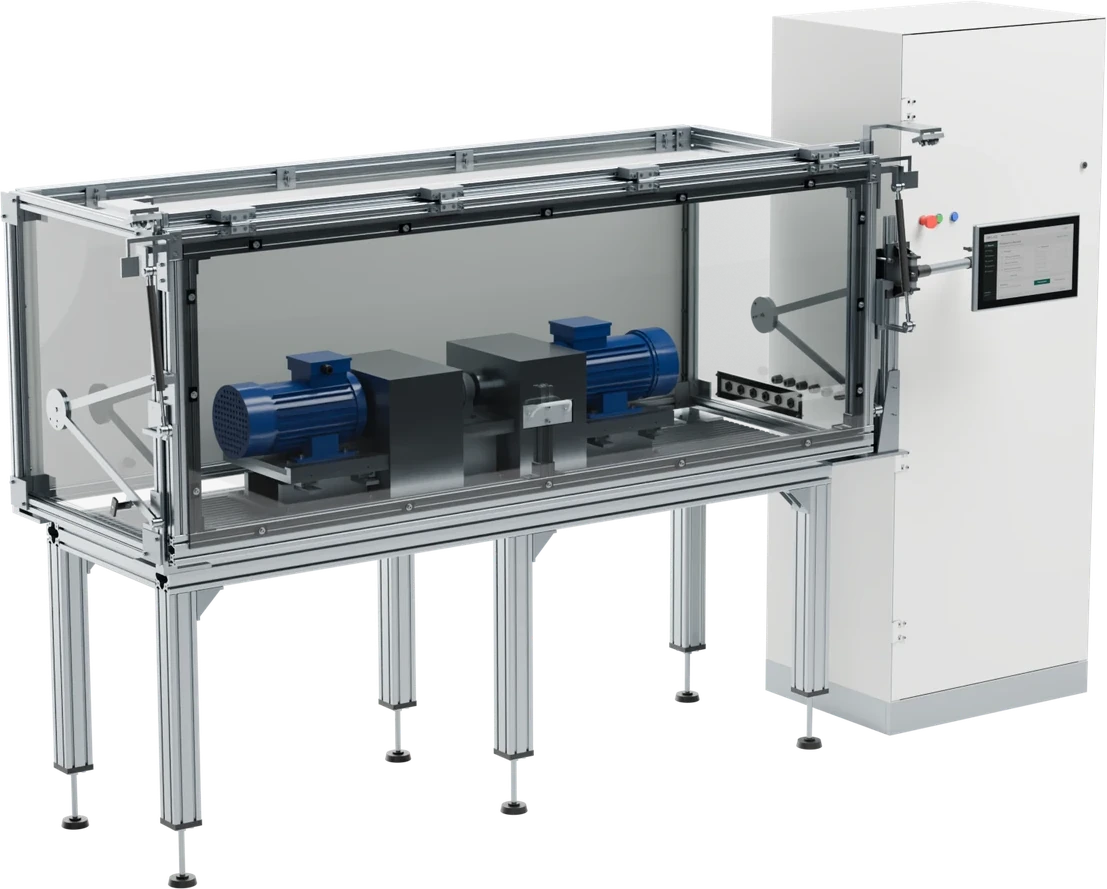
Load testing on the gearbox test bench before installation
After repair, it remains open whether an industrial gearbox runs properly during run-in and under load. The Drive Bench shows this before installation and documents it with measured values.
- Run-in and endurance runTest gearboxes under load after repair
- Torque and speedMeasure at the gearbox input and output
- Test recordEfficiency and measured values in the test report
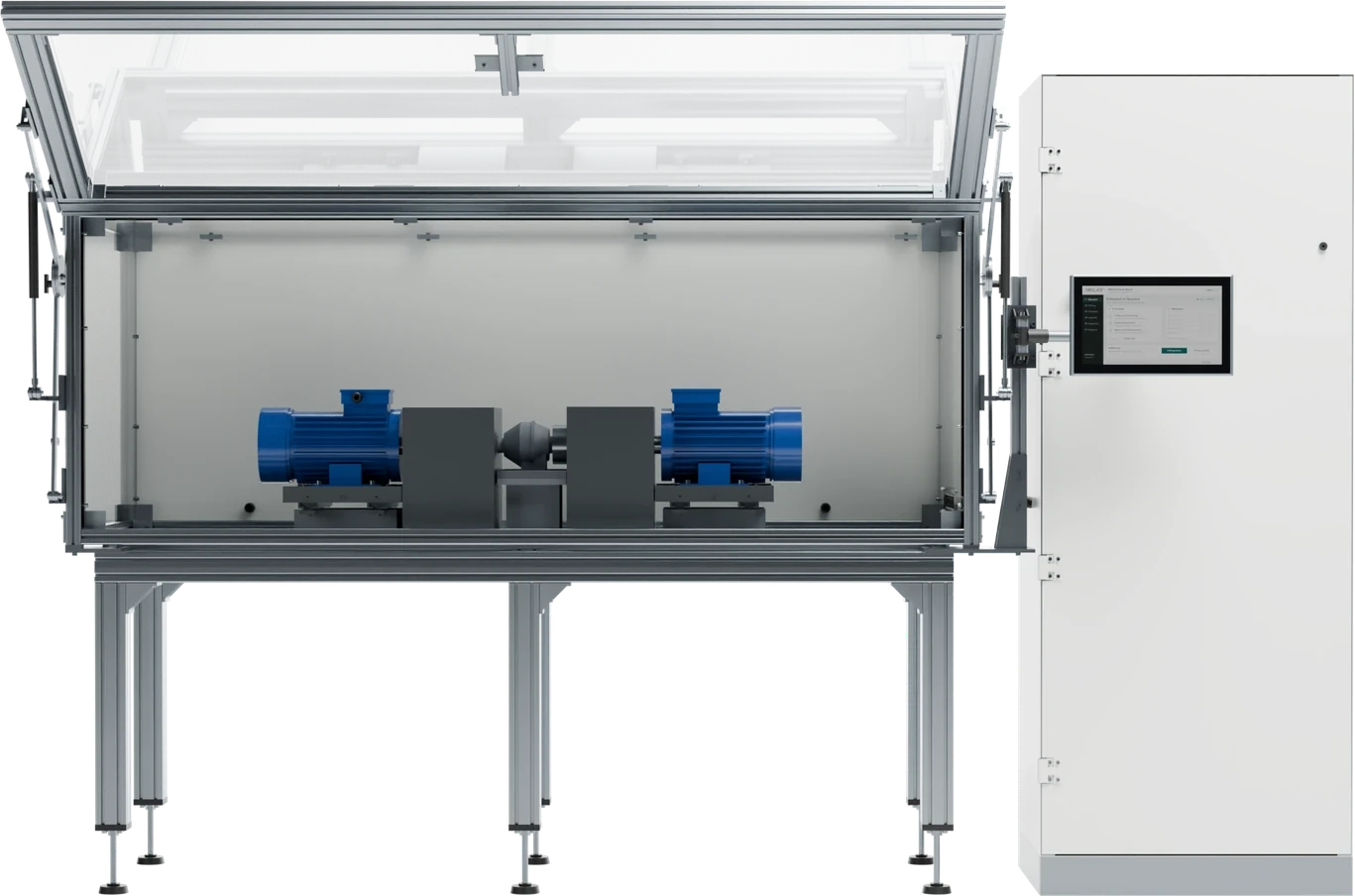
At a glance
Industrial gearboxes
Run-in, endurance run, efficiency
Drive and load machine
Torque and speed
Interchangeable fixtures for each gearbox type
Enclosed test area
Power range and test scope depend on the gearbox type and test specification.
What the gearbox test bench measures
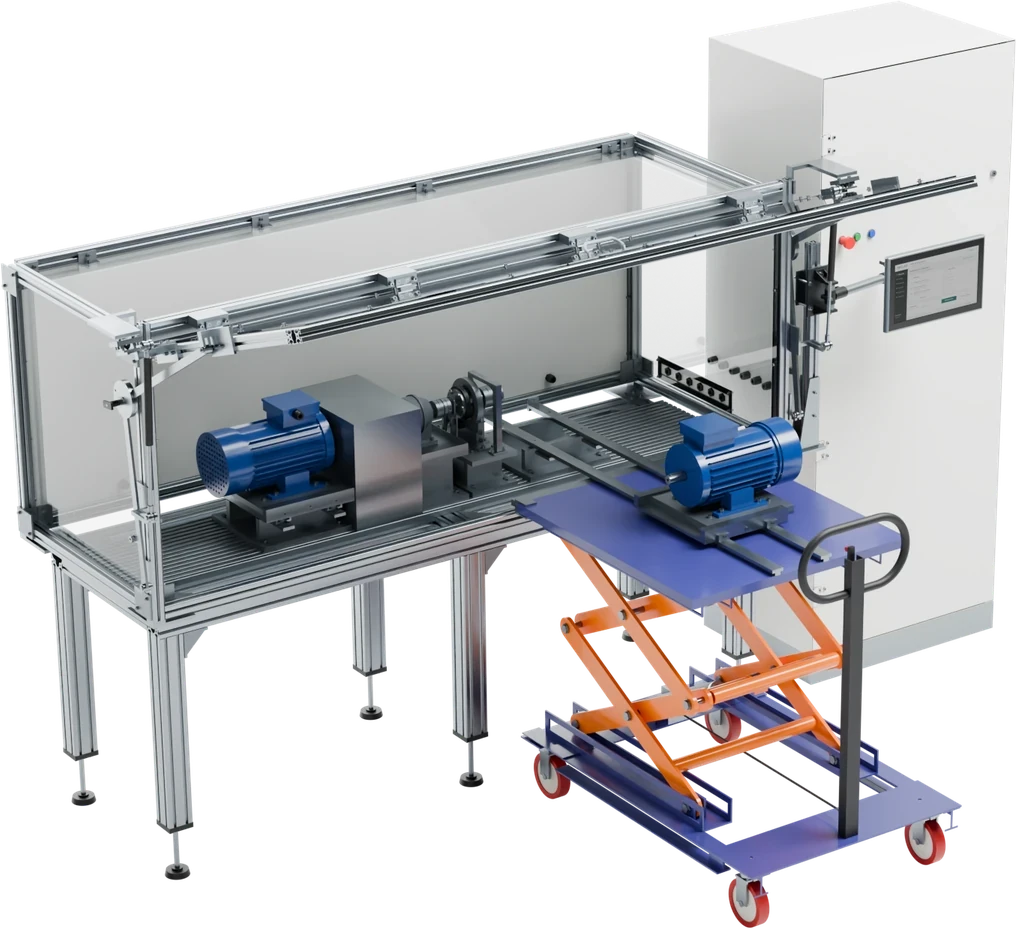
Two measuring points close to the gearbox record torque and speed upstream and downstream of the gearbox. The drive machine, regenerative load machine and interchangeable fixture sit on a rigid machine bed. A protective enclosure, an oil drip tray and a roof segment for crane loading are part of the test area.
Torque
Record the torque upstream and downstream of the gearbox at two measuring points close to the gearbox. The torque measurement determines the accuracy of the efficiency.
Speed
Record the speed at the input and output. The speed ratio gives the transmission ratio.
No-load torque
Measure the torque at the input without load. Before the load stages, it shows how freely the gearbox runs.
Power
Determine the input and output power from torque and speed on both shafts.
Efficiency
Determine the efficiency as output power divided by input power. Oil temperature and load are recorded with the measured value in the report.
Oil and housing temperature
Record the temperature curve during the test run, where the gearbox provides access. If the temperature keeps rising without a higher load, that is a reason to stop the run.
Vibration
Record housing and shaft vibrations, where the gearbox provides access. We clarify the assessment to DIN ISO 20816-9 with your test specification.
Run-in and endurance run
Record measured values over run-in, load stages and endurance run, for each gearbox with serial number and test date.
Testing gearboxes: test sequence, efficiency, load application
How the test runs, how the efficiency can be verified, how the gearbox is loaded and how the condition shows during the run.
The test sequence after repair
The test run follows a fixed order of run-in, no load, load and report. This keeps the measured values comparable, and the gearbox is loaded step by step.
A gearbox first runs without load at low speed. If nothing abnormal shows, load and speed increase step by step up to the operating point. The stages depend on the gearbox type and test specification.
The no-load torque is the torque an unloaded gearbox needs to turn. It results from bearing friction, seals and oil movement and depends on oil level, oil, temperature and speed. Measured at the input, it shows how freely the gearbox runs before the load stages.
Under load, we record torque and speed upstream and downstream of the gearbox. The speed ratio gives the transmission ratio, and both power values give the efficiency. We implement the load stages according to your test specification.
The measured values belong in a report for each gearbox, with serial number and test date. We implement test points, load stages and limit values according to your specification.
How to verify the efficiency of a gearbox
The efficiency is the output power divided by the input power. This requires torque and speed on both shafts.
The shaft power results from torque and speed. If you measure both upstream and downstream of the gearbox, the ratio of the two power values gives the efficiency. That is why our two measuring points sit directly on the gearbox.
Losses occur in the gearing, bearings, seals and in the oil. Part of them increases with torque. The load-independent part, for example from churning in the oil, also occurs at no load and weighs more heavily at low load.
The accuracy of the efficiency depends mainly on the torque measurement. A torque calculated from shaft torsion is usually less accurate than a calibrated transducer in the shaft line.
The efficiency depends on oil temperature and viscosity. A value is meaningful once the temperature has stabilised. Oil temperature and load therefore belong in the report with the measured value.
How the gearbox is loaded on the test bench
The gearbox needs a counter-torque. A brake, a regenerative load machine and mechanical back-to-back loading are common, with different consequences for heat, energy and effort.
A brake converts the test power into heat, which must be dissipated, usually via water cooling.
A regenerative load machine brakes the gearbox electrically, and the torque can be controlled freely. The power is produced as electrical energy and can be fed back into the grid with a regenerative converter.
With back-to-back loading, two gearboxes turn against each other in a closed loop and the test power circulates. The drive covers only the losses. This requires a second gearbox in the loop and, if the transmission ratio differs, a superimposing gearbox.
The load follows the application of the gearbox. A load spectrum describes how torque and speed are distributed over the operating time. We implement load stages and test duration according to your test specification.
How the condition shows during the run
Temperature, oil, vibration and noise show during the test run how cleanly the gearbox operates. The limit values are specified by the manufacturer or your test specification.
The temperature rises after the start and only stabilises after some time. If it keeps rising without a higher load, speed or ambient temperature, that is a reason to stop the run. We also record oil and housing temperature, where the gearbox provides access.
After the run, seals, covers and housing are checked for oil leakage. On the magnetic plug, a fine grey coating is considered normal wear debris, while coarse chips or glittering flakes indicate damage to the gearing or bearings. An oil drip tray is part of the test area.
The standard DIN ISO 20816-9 assesses housing and shaft vibrations of gearboxes. We also record vibration, where the gearbox provides access. We clarify the assessment to the standard with your test specification.
The standard ISO 8579-1 describes how the airborne noise of gearboxes can be determined. We clarify with your test specification whether a noise test is part of your test task.
More on this in the Knowledge article Testing industrial gearboxes after repair.
Which tests does your gearbox need?
Tell us the gearbox types, torques and speeds. We tell you which load application and which measurements suit your tests.
Testing the motor and gearbox as one unit
With a geared motor, the unit is the test item. Which values apply to the unit and when the motor and gearbox must be measured separately depends on the test task.
Components connected in series have an overall efficiency equal to the product of the individual values. Worked example: a motor with 90 per cent and a gearbox with 95 per cent give 85.5 per cent at the output shaft.
If you measure only at the output of the unit, every characteristic curve applies to the motor and gearbox together. This is sufficient for acceptance and comparison, but does not show where a loss occurs.
Separate values require an additional measuring point for torque and speed between motor and gearbox. Only then can an abnormal loss be assigned to the motor or the gearbox.
You test the individual gearbox on the Drive Bench and the geared motor as one unit on the NIKLAS Motor Bench electric motor test bench.
Test software for run-in, endurance run and efficiency
The test software guides you through the test plan and creates the test report. It is the same test software as on our other test benches.
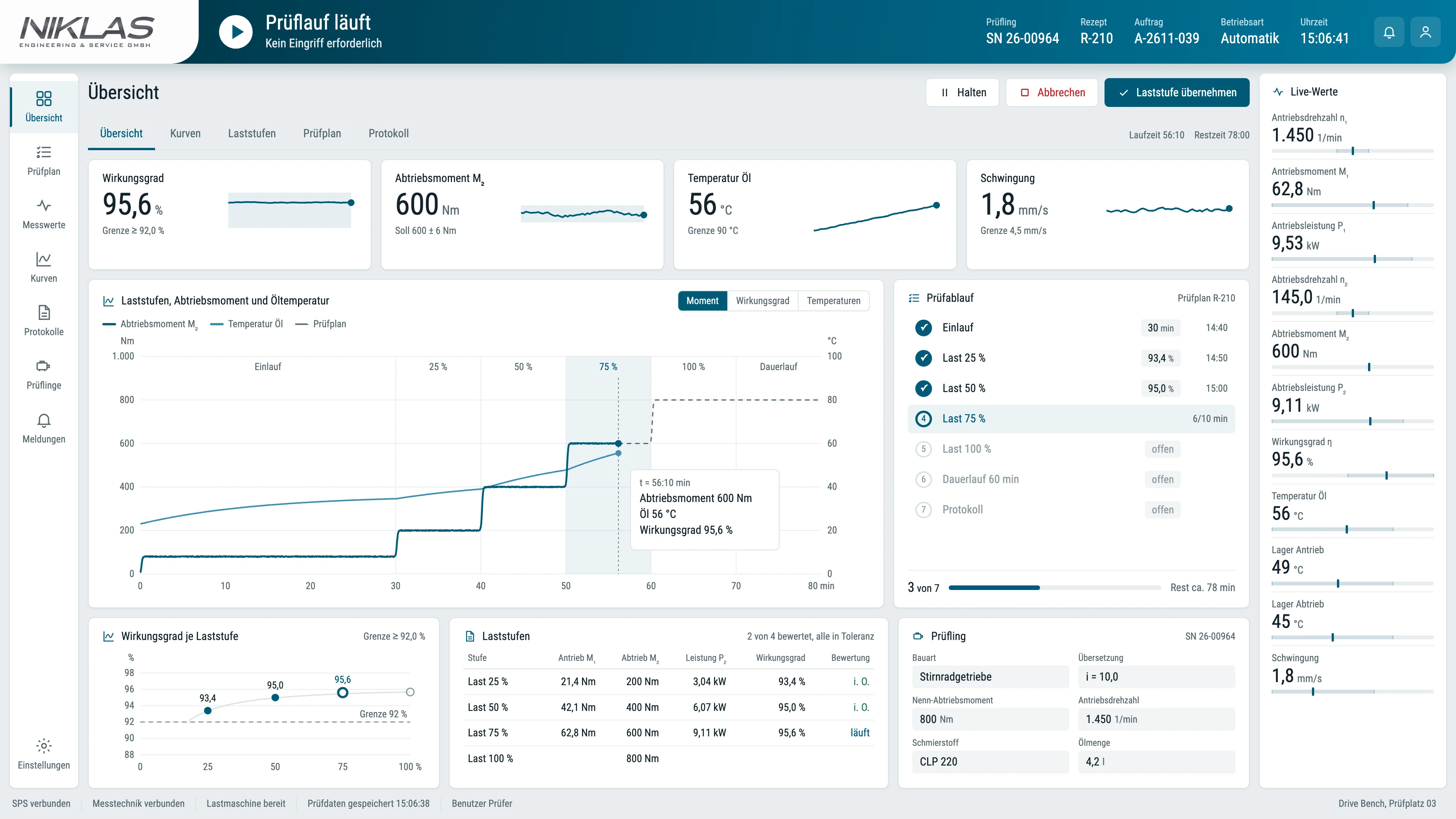
Concept view of the test software. Range of functions depending on the configuration.
For testers and repair shops
Run-in, load stages and endurance run as a stored sequence.
Torque, speed and efficiency for each gearbox.
With serial number and test date for each gearbox.
Frequently asked questions about the gearbox test bench
We answer questions about the test scope, measurement, design and guarding of the gearbox test bench. Power range and test points depend on your gearboxes.
What is a gearbox test bench?
A gearbox test bench drives a gearbox, loads it and measures torque and speed. This gives run-in, endurance run and efficiency. Our Drive Bench is an electric gearbox test bench with a drive machine and a regenerative load machine.
How is the efficiency of a gearbox measured?
You measure torque and speed at the input and output and divide the output power by the input power. The Drive Bench records both variables at two measuring points close to the gearbox, upstream and downstream of it.
How accurate is an efficiency measurement on a gearbox test bench?
The torque measurement determines the accuracy, because every error in the torque goes into the efficiency. We select the measuring range and transducer according to the smallest and largest torque of your gearboxes.
What is a back-to-back test bench?
A back-to-back test bench connects two gearboxes against each other in a closed loop, the test power circulates and the drive covers only the losses. Our Drive Bench, by contrast, applies load with a regenerative load machine.
How is a gearbox run in after repair?
In stages: first without load at low speed, then with increasing load and speed as long as nothing abnormal shows. We define the stages according to the gearbox type and test specification.
Can I test the motor and gearbox as one unit?
Yes, the characteristic curve then applies to the whole unit, and the overall efficiency is the product of motor and gearbox efficiency. Separate values require additional measuring points between motor and gearbox. You test the geared motor as one unit on the Motor Bench.
Which gearboxes can be tested?
The Drive Bench is designed for industrial gearboxes. Interchangeable fixtures for foot, flange or torque arm mounting accommodate different gearbox types, and we define the torque and speed range according to your gearboxes. We are also happy to discuss special designs and unusual sizes.
What information helps for a quotation?
Gearbox types with dimensions, weight and mounting, torque, speed, the tests you require, tests per day and the installation site with available space and mains connection. We ask you for any missing information.
Discuss a gearbox test bench for your test task
Describe the gearbox type, torque and quantity. We are also happy to discuss special designs. We get back to you with a proposal for the fixture, measuring equipment and sequence.

Simon Niklas
Mechanical engineer, M.Sc.
+49 941 56956720[email protected]
“Good engineering proves itself in day-to-day production. That is why we combine technical planning with a close understanding of process, operation and maintenance.”
Book a consultation