
NIKLAS Pump Bench
Pump test bench to DIN EN ISO 9906 with characteristic curve and efficiency
With the NIKLAS Pump Bench, our pump test bench, you measure the characteristic curve, shaft power and efficiency of centrifugal pumps to DIN EN ISO 9906. We design the test circuit, drive and measuring equipment for your pump types.
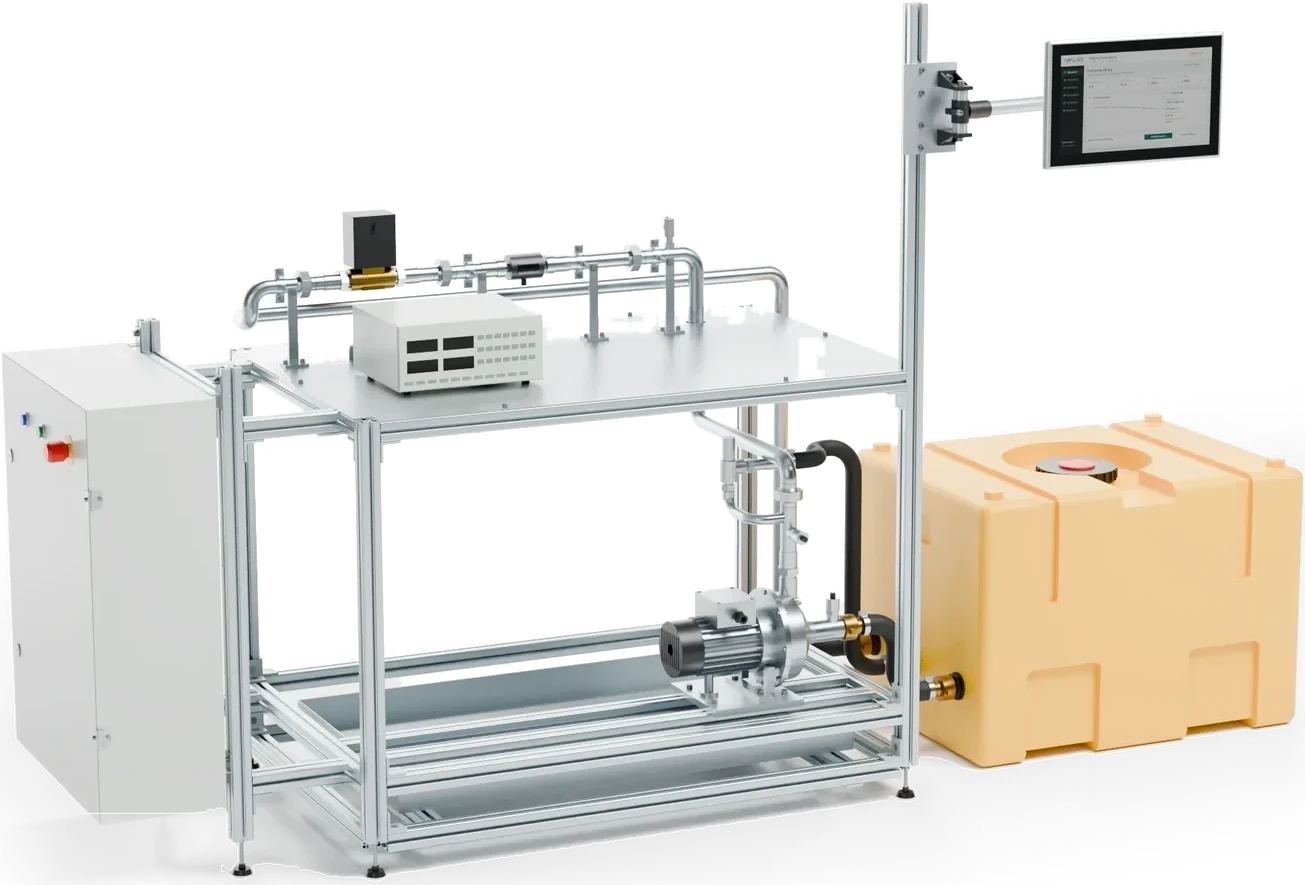
Testing pumps in-house
After repair, a pump should show that it reaches its characteristic curve again. For this, the measurement set-up, connections and report must suit the pump and the test specification.
- Record the characteristic curveFlow rate, pressure and head across the operating range
- Power and efficiencySpeed and shaft power at each operating point
- Test recordReport for each pump with serial number and test date
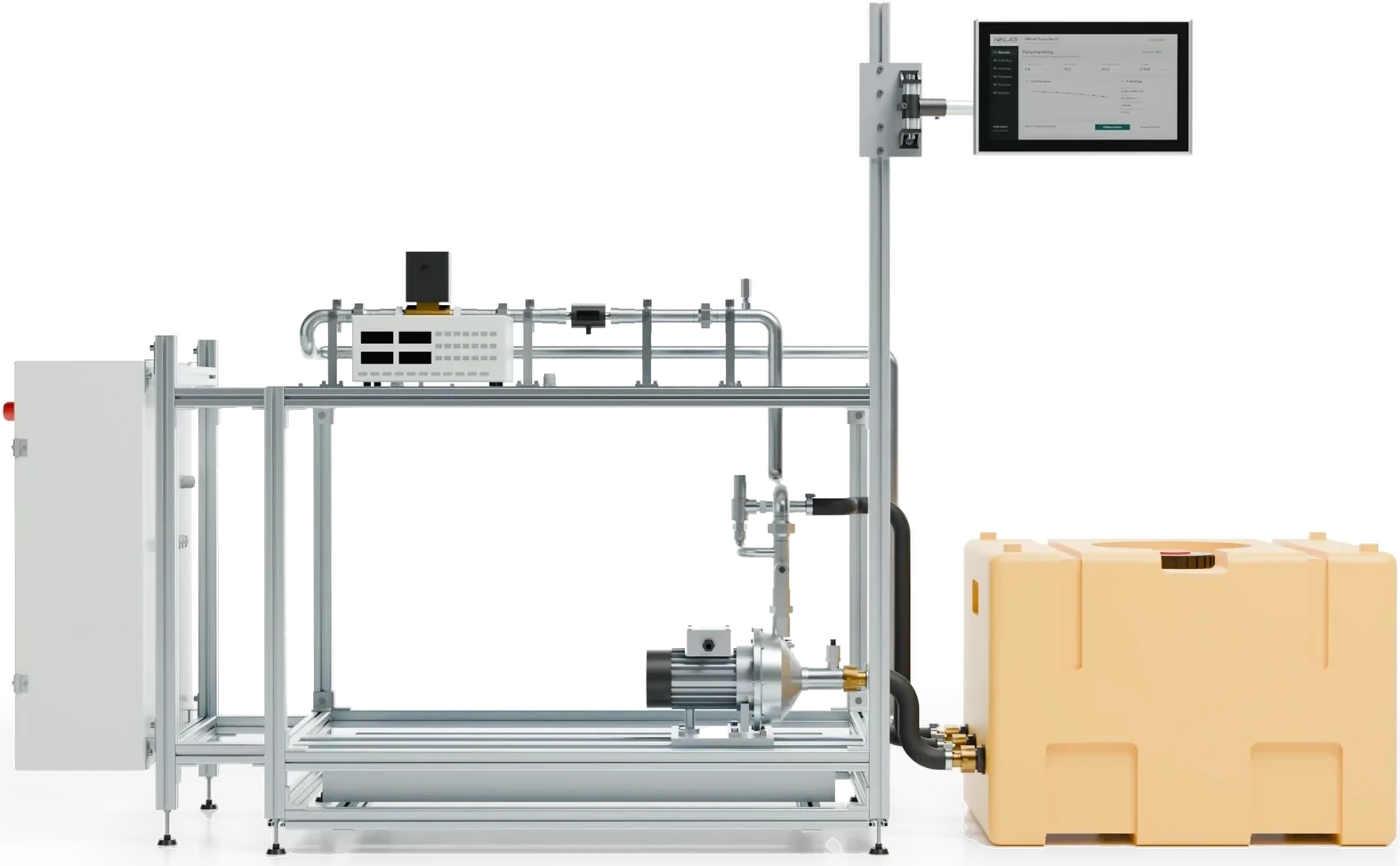
At a glance
Centrifugal pumps
Characteristic curve, power, efficiency
DIN EN ISO 9906
Test circuit with guarding on rotating parts
With serial number and test date
According to your pump types
Test circuit and test scope depend on the pump type and test specification.
What the pump test bench measures
The test bench measures flow rate, pressure, speed and shaft power at each operating point and uses them to determine head and efficiency. We design the test circuit, fixture and guarding on rotating parts according to your pump types.
Flow rate
Record the flow rate across the operating range of the pump. Each flow rate approached gives one measuring point of the characteristic curve.
Pressure
Measure the pressure on the suction side upstream and on the discharge side downstream of the pump.
Head
Determine the head from the pressure head, the height of the measuring points and the velocity head.
Speed
Record the speed at each operating point. If the pump does not run exactly at rated speed, the values are converted.
Shaft power
Record the shaft power at each operating point. It results from torque and speed at the pump shaft.
Hydraulic power
Calculate the hydraulic power from density, gravitational acceleration, flow rate and head.
Efficiency
Determine the efficiency at each operating point as hydraulic power divided by shaft power.
Characteristic curve
Head, power and efficiency plotted against flow rate as a diagram in the test report, for comparison with the guarantee point and the manufacturer's characteristic curve.
Testing pumps to DIN EN ISO 9906: measured variables, set-up and evaluation
What a pump test bench measures, where it measures, which standard applies and how the characteristic curve can be evaluated.
What a pump test bench measures
The characteristic curve of a centrifugal pump plots head, power and efficiency against flow rate. Four variables are measured or calculated for this.
The flow rate is the volume the pump delivers per unit of time at the outlet, usually in m³/h or l/min. We record it across the operating range of the pump. Each flow rate approached gives one measuring point of the characteristic curve.
The head is the difference between the total heads at the outlet and the inlet of the pump. It is made up of pressure head, height of the measuring point and velocity head and is stated in metres.
The shaft power is the power the drive delivers to the pump shaft. It results from torque and speed. We record speed and shaft power at each operating point.
The pump efficiency is the hydraulic power divided by the shaft power. The hydraulic power results from density, gravitational acceleration, flow rate and head. We determine it at each operating point.
Where and how the test bench measures
Measuring points, inlet section and pump connection affect the measured characteristic curve. That is why we design the set-up according to the pump type and test specification.
The pressure is measured on the suction side upstream and on the discharge side downstream of the pump. The pipe diameter and height of the two measuring points go into the head and must be taken into account in the evaluation.
The flow rate is usually recorded by a flowmeter in the pipeline. It needs straight inlet and outlet sections; for electromagnetic flowmeters, manufacturers state about five nominal diameters upstream and two downstream.
The shaft power is measured directly with a torque measuring hub between drive and pump, which often also supplies the speed. It can only be derived from the electrical power of the motor via the motor efficiency, which is uncertain with converter drives.
A test circuit usually consists of a tank, suction and discharge lines, a throttle valve for the operating points and the measuring points. Your pump types get a fixture and connections according to their design, flange size and drive power.
DIN EN ISO 9906 and its acceptance grades
The standard governs hydraulic acceptance tests of centrifugal pumps. It covers tolerances, measurement uncertainty and the test procedure.
The standard applies to centrifugal, mixed flow and axial pumps of any size that pump liquids behaving like clean, cold water. It refers to tests on the test benches of manufacturers or laboratories.
Grade 1 has the tightest tolerances, grade 2 wider ones, grade 3 the widest. The 2013-03 edition subdivides them into 1B, 1E, 1U, 2B, 2U and 3B. The grade is agreed.
The guarantee point is a point of flow rate and head that the pump must reach within the agreed tolerance. The guarantee is considered fulfilled if the measured characteristic curve meets the tolerance limits around this point.
The standard also covers the measurement uncertainty of the measured variables and the test conditions. We define the grade and measurement set-up with you according to your specification and record them in the quotation.
Evaluating the characteristic curve after repair
A characteristic curve only becomes meaningful in comparison: with the guarantee point, with the manufacturer's characteristic curve and with earlier measurements of the same pump.
After repair, you compare the measured characteristic curve with the manufacturer's characteristic curve. Clearances enlarged by wear shift the operating point and reduce the hydraulic efficiency.
If the pump does not run exactly at rated speed during the test, the values are converted: flow rate in proportion to speed, head to its square, power to its cube. Strictly speaking, these rules only apply to frictionless flow without cavitation.
The net positive suction head, NPSH for short, shows the pressure reserve against cavitation at the pump inlet. Cavitation reduces head and efficiency, causes noise and erodes material. We clarify in advance whether your test bench should measure the suction behaviour.
The characteristic curve and measured values are the evidence for customers and inspectors. The test report contains the characteristic curve as a diagram, the serial number and the test date for each pump.
More on this in the Knowledge article Pump testing to ISO 9906: acceptance grades 1B, 2B and 3B.
Which pumps do you want to test?
Tell us the pump types, flow rates and heads. We tell you which test bench set-up suits your tests.
Testing fire-fighting centrifugal pumps: DIN EN 1028 and DIN 14420
Fire-fighting centrifugal pumps with priming device are described in the DIN EN 1028 series of standards. For testing in the fire-fighting vehicle, DIN 14420 also applies. Type testing and approval remain the responsibility of the competent bodies; the test bench supplies measured values and a report for each pump.
Part 1 contains the classification as well as general and safety requirements, part 2 the verification of conformity. The standard applies to the pump without drive and couplings.
Among other things, the standard covers nominal delivery pressure, nominal flow rate, nominal geodetic suction head, shut-off pressure, efficiency and guarantee points. Pump manufacturers often state their guarantee points at 3 m and 7.5 m geodetic suction head.
A throttle on the suction side can simulate the suction head, so a deep suction well is not needed. DIN 14420 describes this procedure for information. We clarify in advance whether your test task requires it.
DIN 14420 covers the suction and discharge side equipment and the individual test of the pump in the fire-fighting vehicle with an inspection report. It requires type testing to DIN EN 1028-2 to have been carried out.
Test software with characteristic curve and report
The test software guides you through the test plan, shows the characteristic curve as a diagram and creates the test report with serial number and test date.
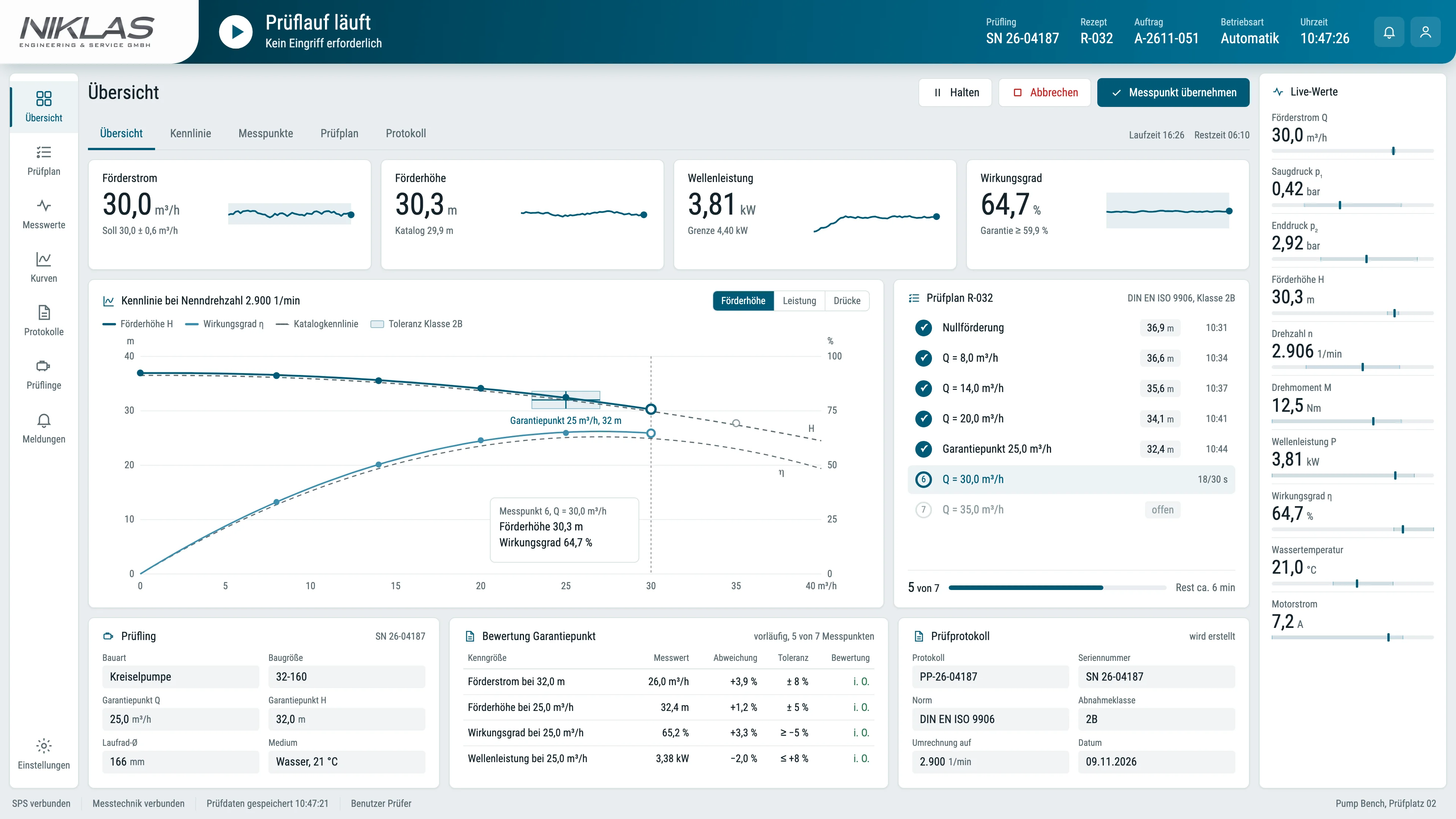
Concept view of the test software. Range of functions depending on the configuration.
For testers and repair shops
Test points and grade according to your specification as a stored sequence.
Head and pressure against flow rate, shown for each pump.
With serial number and test date for each pump.
Frequently asked questions about the pump test bench to ISO 9906
Here we answer what repair shops and operators need to know before enquiring about a test bench.
How do you record the characteristic curve of a centrifugal pump?
You approach several flow rates and measure head, shaft power and speed at each one. The measuring points give the curves for head, power and efficiency against flow rate.
How do you calculate the efficiency of a centrifugal pump?
The efficiency is the hydraulic power divided by the shaft power. The hydraulic power is density times gravitational acceleration times flow rate times head.
Which accuracy grades does ISO 9906 define?
The standard defines grades 1, 2 and 3, subdivided into 1B, 1E, 1U, 2B, 2U and 3B, with grade 1 having the tightest tolerances. Which grade applies is specified by your standard and your customer.
How do you convert a characteristic curve to rated speed?
With the affinity laws: the flow rate increases in proportion to speed, the head with its square and the power with its cube. Strictly speaking, they only apply to frictionless flow without cavitation.
What is the NPSH value of a pump?
The NPSH value, net positive suction head, is the pressure reserve above the vapour pressure at the pump inlet. NPSH3 is common: the value at which the head drops by 3 per cent due to cavitation at a given flow rate and speed.
How do you test a fire-fighting centrifugal pump to DIN EN 1028?
Part 2 of DIN EN 1028 governs the verification of the requirements, and DIN 14420 the individual test after installation in the vehicle. Type testing and approval remain the responsibility of the competent bodies. We discuss with you, on the basis of the standard, which measurements your test bench should cover for this.
Can the pump test bench also test pumps for media other than water?
As standard, we test with water; ISO 9906 applies to liquids that behave like clean, cold water. For other media, temperatures or contamination, we plan the test circuit, materials and protection for each project.
What information helps for a quotation?
Pump types with design, connection sizes, weight and drive power, plus standard and grade, test points, test medium, tests per day and installation site with water and power connections. Rough information is enough, and we ask about anything missing.
Discuss a pump test bench for your test task
Describe the pump type, drive power and quantity. We are also happy to discuss pumps outside the usual designs. We get back to you with a proposal for the test circuit, measuring equipment and sequence.

Simon Niklas
Mechanical engineer, M.Sc.
+49 941 56956720[email protected]
“Good engineering proves itself in day-to-day production. That is why we combine technical planning with a close understanding of process, operation and maintenance.”
Book a consultation