

CE and machine safety
CE marking for machines and installations
Whoever substantially modifies a machine or combines several machines into an installation is regarded as the manufacturer and needs a risk assessment, technical documentation, operating instructions and a declaration of conformity for the new state. We support you with the CE marking of machines up to the declaration of conformity.
Substantial modification: when you become the manufacturer
A modification makes the operator the manufacturer as soon as the change is substantial. Open questions usually concern the threshold for a substantial modification, the documents and the change of legal basis in 2027.
When a modification to the machine is substantial
Under the Machinery Regulation, a substantial modification creates a new hazard or increases a risk and requires additional protective measures. Repair and maintenance without safety consequences are not included.
Whoever makes a substantial modification takes on the manufacturer role
This applies to a company that carries out the modification itself as well as to the service provider who carries it out. The manufacturer bears the obligations under Article 10 and declares conformity on its own responsibility.
New documents for the modified machine
The original manufacturer's declaration applies to the machine as delivered. Separate technical documentation is created for the modified machine and must be kept for at least ten years.
Selected customers
















Machines and installations for which we prepare CE documents
CE marking applies to individual machines as well as to linked installations. We prepare the risk assessment, technical documentation and declaration of conformity for these groups of installations:
Machines for manufacturing, forming, machining and processing parts or materials.
Assembly stations, robot cells and systems for feeding, joining or positioning.
Systems for material transport, sorting, product guidance and packaging.
Test benches and custom-built machines for defined processes and particular production tasks.
Your machine belongs to a different group? Feel free to send us an enquiry.
Assessment, documents and declaration of conformity
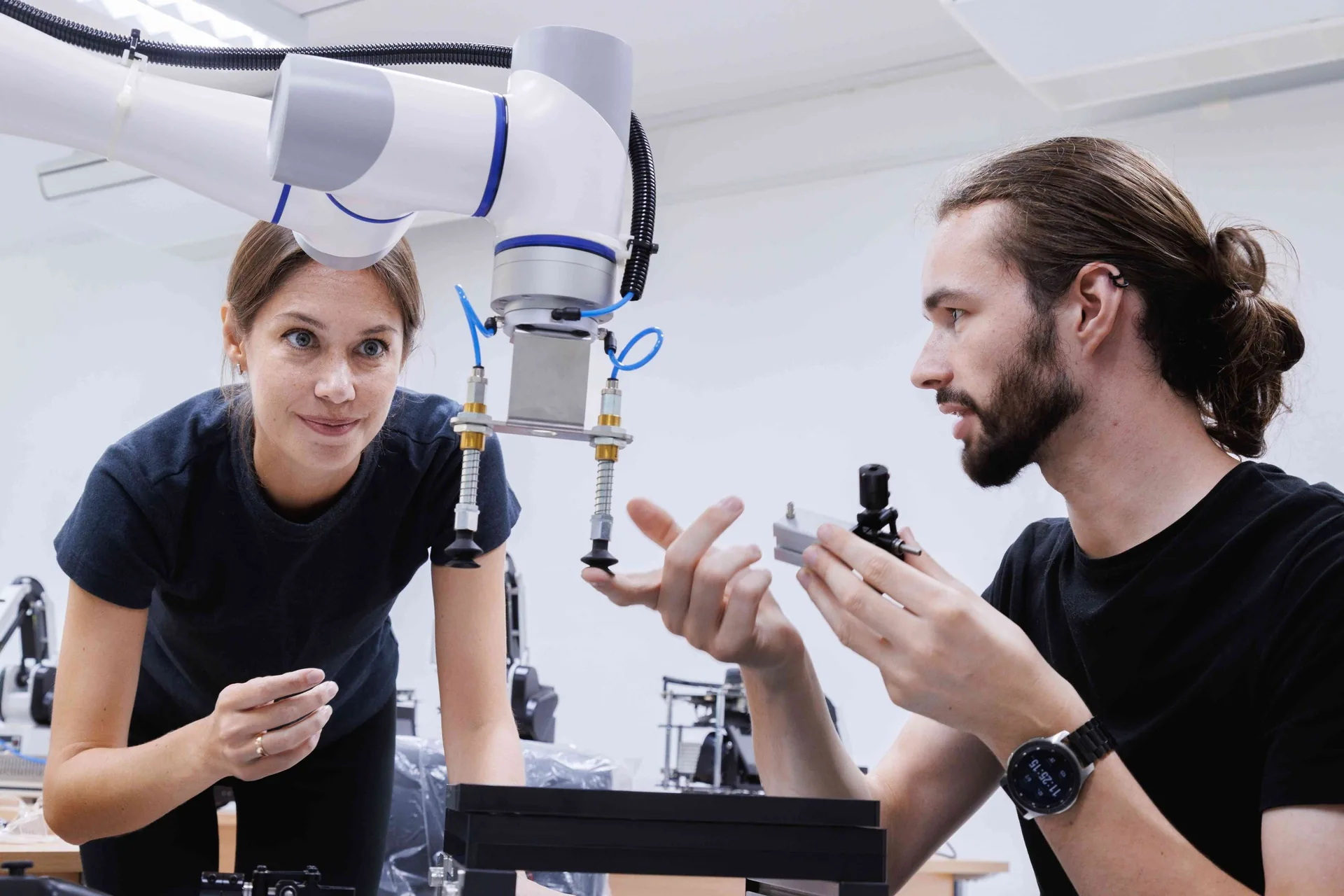
Our CE consulting starts by checking whether your modification is a substantial modification. If so, we prepare the documents for the CE marking together with you and document every step.
Substantial modification
We assess the substantial modification using a fixed procedure and justify the result in writing.
Risk assessment
We prepare the risk assessment to DIN EN ISO 12100 with protective measures and residual risks.
Technical documentation
We prepare technical documentation and operating instructions for the modified state of the machine.
Declaration of conformity
Conformity assessment, declaration of conformity and CE marking by the manufacturer.
Have you modified your machine?
Describe the modification to us. We clarify with you whether it is a substantial modification and which documents you need.
Installations, partly completed machinery and documents
Besides the modification of a single machine, CE marking also concerns installations made up of several machines, partly completed machinery, the documentation and the Machinery Regulation from 2027. Choose a topic.
Assembly of machinery: CE marking for installations
If several machines work together as a whole, the installation itself counts as a machine. Whoever puts it together assumes the manufacturer's obligations for the assembly as a whole.
We define which machines, feeders, robots and conveyors belong to the assembly. The boundary determines which hazards the assessment covers.
We coordinate the emergency stop, protective devices and interlocks of the individual machines for the assembly as a whole.
Declarations of conformity and operating instructions of the individual machines are incorporated into the documents for the assembly.
The manufacturer of the assembly issues the declaration of conformity and affixes the CE marking.
Declaration of incorporation for partly completed machinery
Partly completed machinery only works after it has been incorporated into another machine or installation. Different documents apply to it than to a complete machine.
The manufacturer declares which requirements the partly completed machinery meets and which are only met through incorporation.
They describe how the partly completed machinery is to be incorporated and connected so that the complete machine remains safe.
Only the complete machine receives the CE marking.
Whoever incorporates the partly completed machinery needs the declaration and the instructions for their own conformity assessment.
Preparing operating instructions and keeping technical documentation
CE marking includes operating instructions for users and technical documentation for inspections by authorities.
They describe the use, commissioning, operation, maintenance and residual risks of the machine for the operator.
The operating instructions are provided in the language of the country in which the machine is operated.
You keep the risk assessment, drawings, applied standards and inspection reports for at least ten years.
After a change to the machine, the instructions and documents are brought up to date.
Machinery Regulation 2027: what is new for new and modified machines
From 20 January 2027, the Machinery Regulation (EU) 2023/1230 applies directly in every member state and replaces the Machinery Directive 2006/42/EC. New requirements cover software, cybersecurity and learning systems. We summarise the key points in the Knowledge article Machinery Regulation 2027.
What counts is the first making available in the EU, not the order. Deliveries and substantial modifications from the key date onwards fall under the Regulation.
Safety-related hardware, software and data must be protected against corruption. Interventions must be traceable, including via remote access and connected devices.
Safety functions with self-evolving behaviour through machine learning are listed in Annex I Part A. Procedures involving a notified body apply to them.
Operating instructions and the declaration of conformity may be provided digitally. If requested at the time of purchase, the manufacturer supplies the instructions on paper free of charge.
What we clarify before a quotation
Effort and duration depend on what you change, which documents are available and whether your machine belongs to the types of machinery in Annex I of the Machinery Regulation.
What exactly are you changing?
New controls, modified protective devices, more power or a new function: we determine which change affects the safety of the machine.
Is the machine listed in Annex I?
For certain types of machinery, such as presses with manual loading, a notified body may be required. This body carries out the examination itself. We clarify this before the quotation.
Who takes on the manufacturer role?
If a service provider carries out the modification, it can become the manufacturer. Before the order, we record in writing who assumes the manufacturer's obligations for the modification.
Which documents are available?
Operating instructions, circuit diagrams, declaration of conformity and previous risk assessment of the machine. We record anything missing during the inventory.
Modification and documentation step by step
We assess the modification before it is carried out. We then prepare the risk assessment and the documents and hand them over together with the modified machine.
We compare the state before and after the modification and check whether a new hazard or a higher risk arises.
We carry out the risk assessment, define protective measures and test the safety functions of the modified machine.
We prepare technical documentation and operating instructions for the new state. The manufacturer issues the declaration of conformity and affixes the CE marking.
Service after CE marking
The CE documents record a state at a particular point in time. Afterwards we modify the machine further if required, update the documentation and test the safety functions at regular intervals.
Retrofit and modification
We modify controls, drives and safety technology and document the changes.
Documentation
After changes, we update circuit diagrams, program versions and technical documentation.
Recurring inspection
We include the inspection dates in an annual contract or in NIKLAS CARE.
Frequently asked questions about CE marking for machines
Answers for operators and design engineers before a modification. The text describes the procedure and the documents and is not legal advice.
When is a modification to a machine substantial?
Under Article 3 of the Machinery Regulation (EU) 2023/1230, a substantial modification is an unforeseen change that creates a new hazard or increases an existing risk.
As a result, either protective devices must be added whose integration changes the safety-related control system, or additional measures are needed for stability or strength.
Until 19 January 2027, the Machinery Directive 2006/42/EC still applies. For Germany, the 2015 interpretation paper of the Federal Ministry of Labour and Social Affairs explains when a modification results in a new machine.
Who is the manufacturer of the machine after a modification?
Whoever makes a substantial modification is regarded as the manufacturer and bears the manufacturer's obligations under Articles 18 and 10 of the Machinery Regulation.
This can be your company, if you carry out the modification yourself, or the service provider who carries out the modification. Record in writing before the order who takes on this role.
If the modification only affects one machine within an assembly of machinery, the manufacturer's obligations apply to this affected machine.
What does CE marking after a modification involve?
The manufacturer assesses the risks, prepares technical documentation and operating instructions, issues the declaration of conformity and then affixes the CE marking.
The technical documentation includes, among other things, the risk assessment, drawings, applied standards, inspection reports and operating instructions (Annex IV of the Machinery Regulation).
We describe and document the procedure and the documents. The conformity assessment shows whether the machine meets the requirements.
What changes on 20 January 2027 for modifications?
From 20 January 2027, the Machinery Regulation (EU) 2023/1230 applies. On this date, the Machinery Directive 2006/42/EC is repealed.
Machines placed on the market under the Directive before this date may continue to be made available (Article 52). The key date alone does not require a reassessment.
In future, a substantial modification is governed by Article 18 of the Regulation. For modifications around the key date, we clarify in advance which law applies.
Do I need a notified body after the modification?
That depends on the machine. For machines not listed in Annex I, the manufacturer's internal production control is sufficient. For machines listed in Annex I, special procedures under Article 25 apply.
For certain types of machine, such as presses or injection moulding machines with manual loading, an examination by a notified body may be required.
The body carries out this examination itself. We clarify before the quotation whether your machine falls under this.
Can software updates also be a substantial modification?
Yes, in individual cases. The Machinery Regulation explicitly mentions physical and digital modifications (Article 3, point 16).
The decisive factor is the safety consequence: does a new hazard arise or does a risk increase, and are additional protective measures needed for this?
An update that fixes errors and leaves safety unaffected is not considered substantial. Nevertheless, document updates to safety-related software.
What changes for operating instructions and the declaration of conformity?
The operating instructions may be provided digitally. The manufacturer keeps them available online for at least ten years after placing on the market (Article 10(7)).
If requested at the time of purchase, the manufacturer supplies the instructions on paper free of charge within one month.
Instead of the declaration on paper, it is sufficient to give an internet address or a machine-readable code in the instructions under which the EU declaration of conformity can be accessed (Article 10(8)).
Does the Retrofit Check replace the CE assessment?
The CE assessment remains a separate step. The Retrofit Check provides an initial technical assessment on site and counts neither as a safety assessment nor as approval of the machine.
The assessment of the substantial modification, the risk assessment and the documents are separate work steps that we agree with you after the check.
Send us the machine type, year of construction, planned change, circuit diagrams and existing declaration of conformity. We will get back to you with a proposal for how to proceed.
Request CE marking for your machine
Tell us the machine type, year of construction, planned change and existing documents such as the circuit diagram and declaration of conformity. We will get back to you with a proposal for how to proceed.

Simon Niklas
Mechanical engineer, M.Sc.
+49 941 56956720[email protected]
“Good engineering proves itself in day-to-day production. That is why we combine technical planning with a close understanding of process, operation and maintenance.”
Book a consultation