
NIKLAS Motor Bench
Electric motor test bench for repair, development and quality assurance
With the NIKLAS Motor Bench you test motors and fans from small motors to large machines, at no load and under load, in a guided sequence. We design the mechanics, measuring equipment and software for your test items.
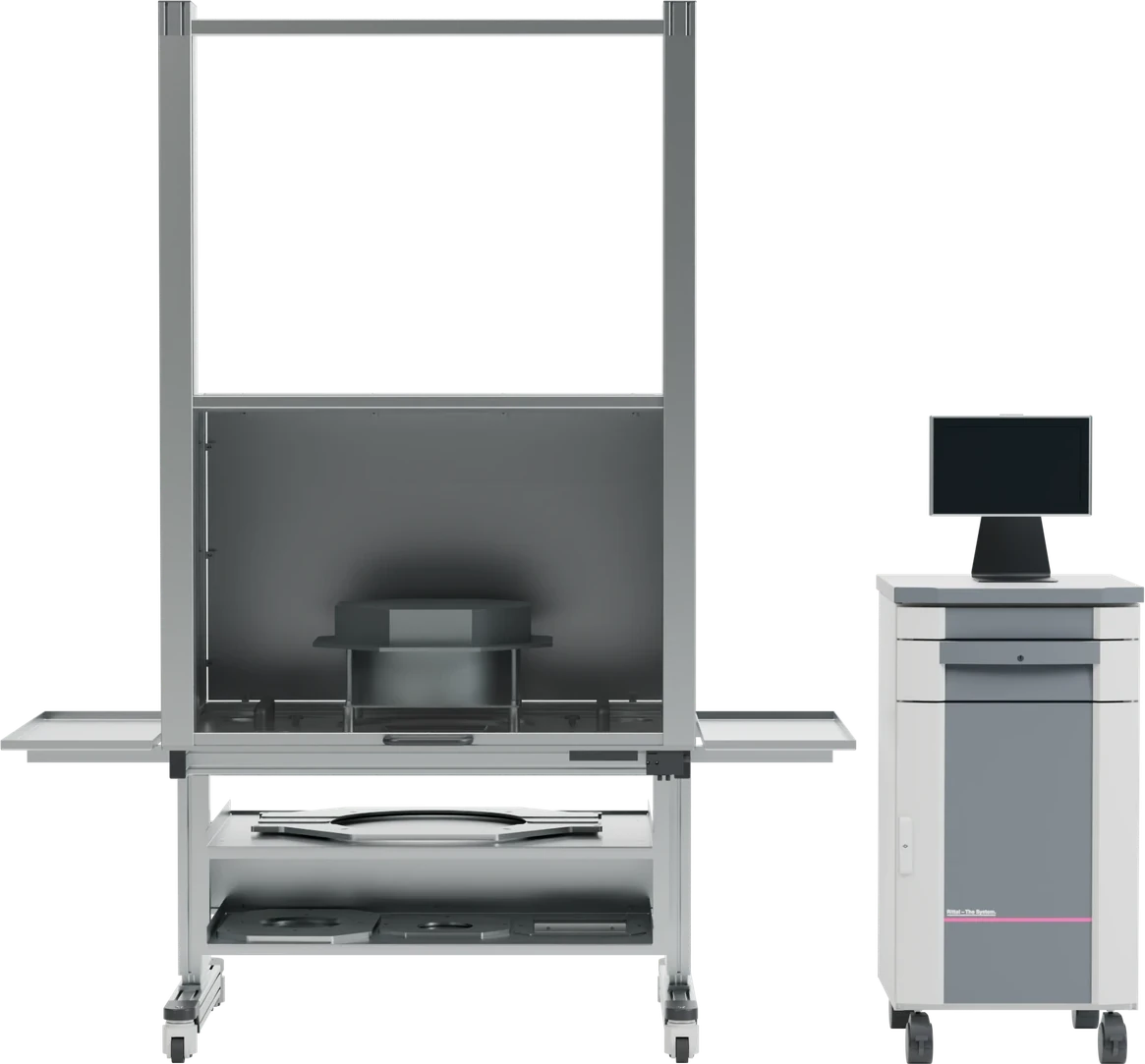
Testing electric motors in-house
With your own electric motor test bench, you record the condition and test history of your motors and fans without sending them out. After an introduction, your staff carry out standardised motor tests themselves. Repeated measurements show whether a motor can keep running or needs maintenance or repair.
- In-houseTest motors and fans with your own staff
- Respond earlyDetect abnormalities and plan maintenance
- Document the conditionHealth Monitor and test report for each motor
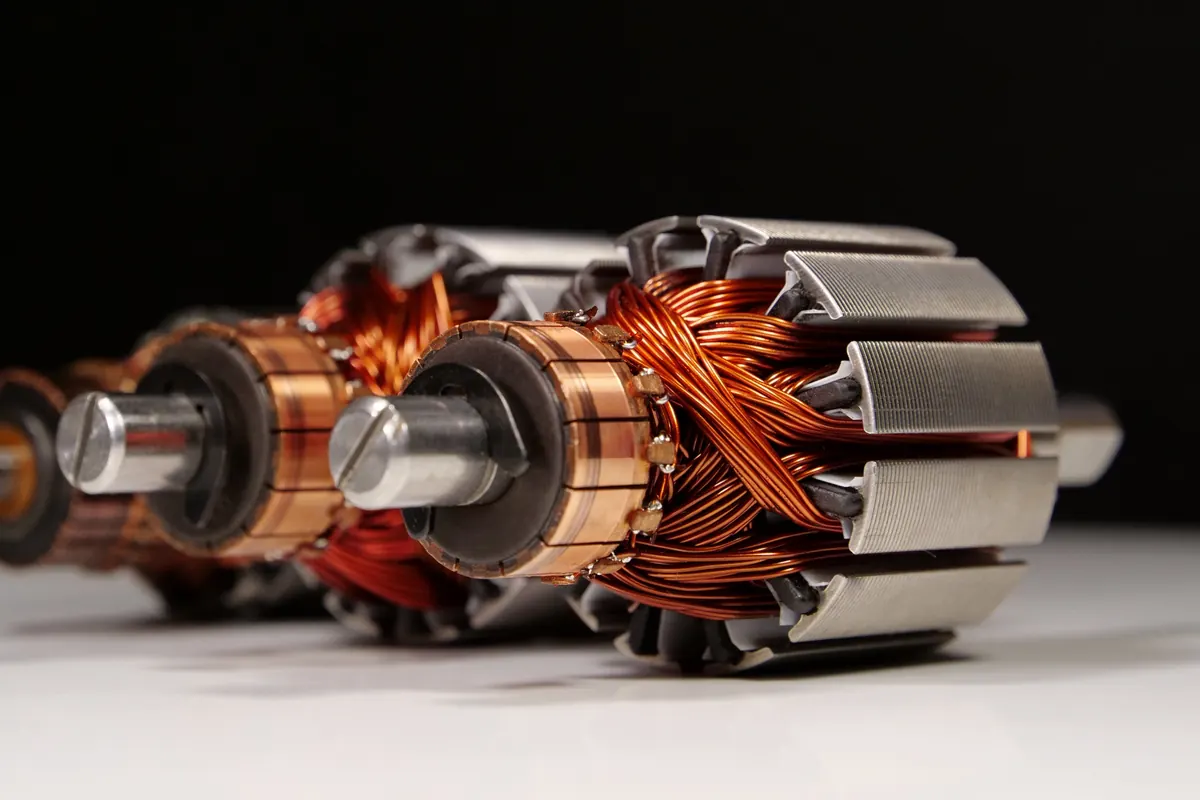
At a glance
Asynchronous, synchronous, DC and BLDC motors, fans
Electrical and mechanical
Limit values agreed with the motor manufacturer
Insulated test chamber
Digital, data interface to ERP
Fixtures for each motor type
Test time and test scope depend on the motor type and test program.
What the electric motor test bench measures
Our electric motor test bench records electrical and mechanical measured values in a guided sequence, including insulation resistance and run-down time. We define test programs, limit values and load tests for your motors and the selected equipment.
Insulation measurement
Record the insulation resistance and assess the electrical insulation of the motor. Repeated measurements help you detect changes at an early stage.
High-voltage test
High-voltage test to assess the electrical dielectric strength. The test voltage and sequence are matched to the motor and the test specification.
Measuring winding resistance
The winding resistance measurement records the resistances of the windings. On three-phase motors, the phase comparison can indicate contact problems or changes in the winding.
Speed measurement
Record the speed during the test sequence and compare it with the specifications of the motor type.
Temperature measurement
Assess the temperature and the heating curve. Abnormal values can indicate increased friction or incipient bearing damage.
Vibration measurement
Assess vibrations to the standard that suits your motor, for example ISO 20816 or DIN EN 60034-14. This shows you imbalances and abnormal bearing conditions.
Current, voltage and power
Record the phase currents I1, I2 and I3 including current imbalance, as well as voltage and power at no load and under load.
Run-down time
Record the run-down time after switch-off. A comparison under the same test conditions can show changes in the mechanical running behaviour.
Testing electric motors: torque, measuring equipment, no load and load
Who tests, how the torque is obtained, how the measuring chain is set up and what is possible at no load and under load.
Who tests with the Motor Bench
Whether small motor or large machine, asynchronous, synchronous, DC or brushless DC motor (BLDC): we design the fixture, load and measuring equipment for your test items.
You test motors after repair or before reinstallation and record the measured values and test history for each motor.
You record characteristic curves under load and compare them with your suppliers' data.
You test no-load speed, current consumption and torque, also on small motors and in series production.
You run operating states, deliberately create fault conditions and save the measurement data.
Calculating or measuring torque directly
Without a torque flange, we determine the torque from the electrical measured variables. This is sufficient to compare motors with each other and over time.
If you want to verify characteristic curves or check them against manufacturer data, you measure the shaft torque directly. The torque flange sits between the test item and the load and is available as a standard option.
Together with the electrical input power, the shaft torque gives the efficiency. The methods for determining losses and efficiency are described in the DIN EN 60034-2 series of standards.
We define with you how accurately the measurement must be made, based on the smallest torque you want to test and the deviation your characteristic curve allows.
If you test both together, the characteristic curve applies to the whole unit. Separate values require additional measuring points. You test gearboxes on their own on the Drive Bench.
Measuring chain and measured variables
The measured values run over an internal EtherCAT network that operates with low latencies.
We record current and voltage for each phase and derive RMS values, power and phase imbalance from them.
Torque and speed come from the torque flange if you choose this standard option.
Electrical and mechanical measured values are synchronised in time so that you can evaluate their curves together. We distinguish between raw signals and calculated RMS and power values.
We record the measuring points, ranges, accuracies and recording rates of your test bench in a list of measured variables.
Testing at no load and under load
Depending on the task, you test without load or run the operating points of your application under load.
Current, voltage and phase imbalance give indications of the winding and contacts, and the vibration measurement shows imbalance and bearing damage. This is sufficient for many repair shops and for incoming inspection.
Torque, heating and efficiency are added. You run through operating points and load spectra and compare them with the manufacturer's characteristic curve.
If you do not need a load, we build the Motor Bench as a no-load test bench. This is also possible for high power ratings, with a frequency converter and adjustable voltage.
For each motor type you get a dedicated test item fixture and a stored test profile. The test bench stays in place, and we add new types later.
More on this in the Knowledge article Surge testing of motor windings.
Which tests does your motor need?
Tell us the motor types and power range. We tell you which measurements and which load set-up suit your tests.
Surge test for motor windings
The surge test sends a short high-voltage pulse to each winding and then compares the decay curves of the phases. It finds interturn faults that resistance and insulation measurements leave undetected.
Schematic diagram: a deviating decay curve indicates an interturn fault.
A short high-voltage pulse goes to each winding. You compare the decay curves of the phases, and deviations reveal interturn faults.
Resistance and insulation measurements often leave interturn faults undetected. That is why the surge test is worthwhile after rewinding and for motors operated on a frequency converter.
We integrate the surge test as an option into the test bench software and the test report.
As a service, we test windings in Wörth an der Donau. More on this in the Knowledge article Measuring motor windings.
The test bench consists of these five modules
Mechanical fixture, electrical connection, measuring and test equipment, test profiles and software.
Module 01Fixtures and adapters for each test item
We design a dedicated mechanical fixture for each intended electric motor and fan. With the adapters, the test item is easy to mount and sits in the same position for every repeat test.
Module 02Three-phase, single-phase or direct current
We design connections and adapters for each intended three-phase, single-phase or DC motor according to its performance data. We design the power range to suit your motors.
Module 03Electrical and mechanical testing
Electrical and mechanical tests as well as vibration measurements run at one station in the insulated test chamber. We select the measuring and test equipment according to your motors and test tasks.
Module 04Agreed with the motor manufacturer
We define test profiles and limit values together with the motor manufacturer. Every test measures against the same limit values, so the results remain comparable. Depending on the configuration, the software uses them to show trends and abnormalities compared with earlier measurements.
Module 05Guided operation and AI condition assessment
After an introduction, even staff without in-depth test engineering knowledge can operate the software, because it guides them through every step. Additional parameters are available in expert mode. Depending on the test bench configuration, an AI analyses the measurement data and shows the motor condition and abnormalities over time in the Health Monitor.
Test bench software with Health Monitor
The test bench software guides you through the motor test and stores measured values and test history for each motor. Depending on the configuration, an AI assesses the condition and points out abnormalities over time.
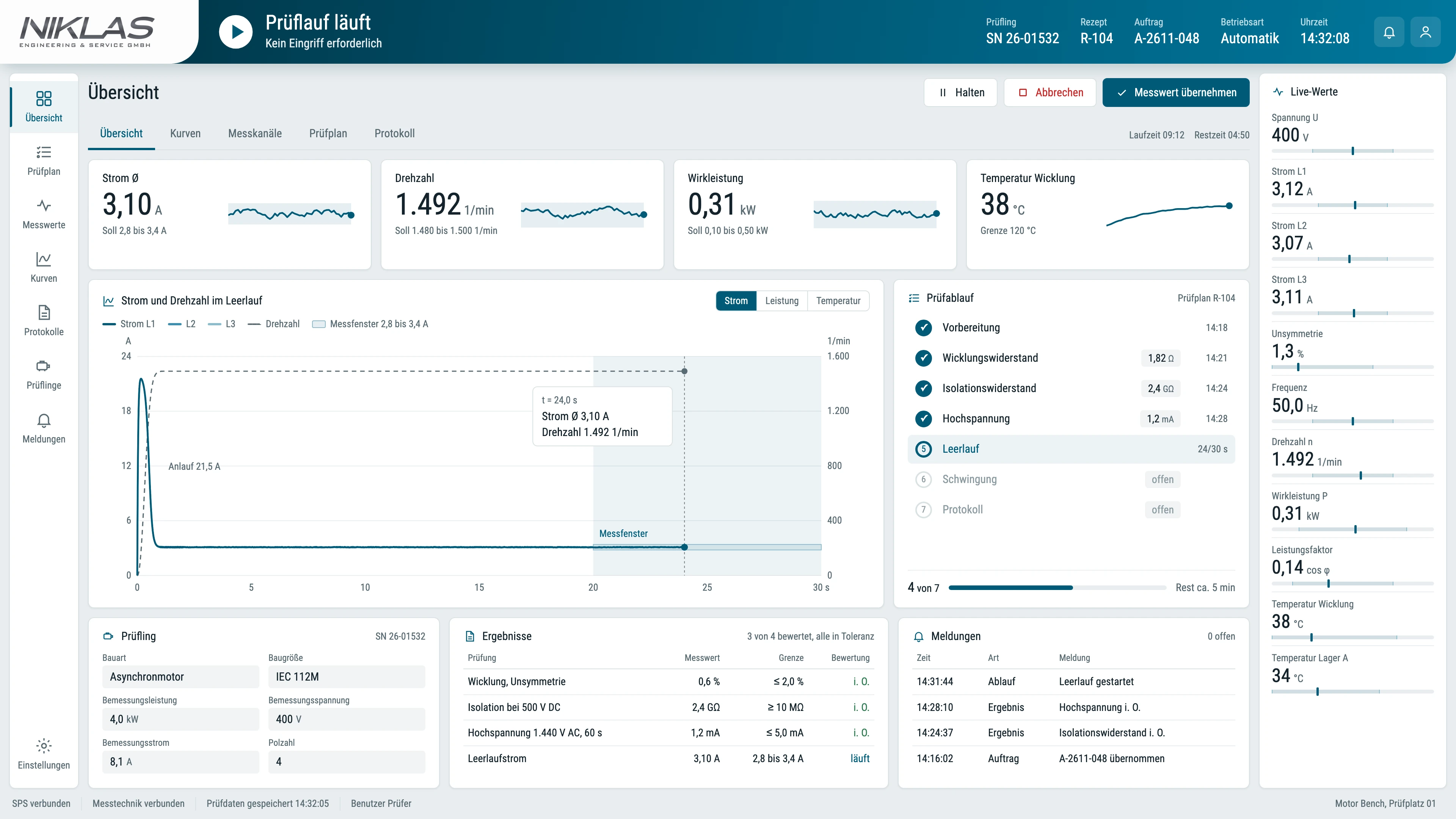
Sample view of the test bench software. Range of functions depending on the configuration.
For operators and specialist users
Stored test profiles specify every work step, fully or semi-automatically, even without in-depth test engineering knowledge.
Additional parameters and settings for experienced users, matched to the motor and test task.
Depending on the configuration, an AI evaluates the measurement parameters, assesses the motor condition and shows abnormalities over time.
Frequently asked questions about the electric motor test bench
We answer questions about motor types, torque, no-load testing, operation, the Health Monitor and the surge test.
What does an electric motor test bench test?
An electric motor test bench tests motors and fans electrically and mechanically in a guided sequence. Among other things, our Motor Bench measures insulation resistance, winding resistance, speed, temperature, vibration, current, voltage, power and run-down time.
In addition, there is a high-voltage test that assesses the dielectric strength. We assess vibrations to the standard that suits your motor, for example ISO 20816 or DIN EN 60034-14.
Which motors can be tested on the Motor Bench?
Three-phase, single-phase, DC and BLDC motors as well as fans, from small motors to large machines.
We design the fixture, connections and adapters for your test items. We are also happy to discuss motors outside the usual designs and sizes, just tell us the motor type and performance data.
Is the torque measured or calculated?
Both. Without a torque flange we calculate it from the electrical measured variables, and with the standard torque flange option we measure the shaft torque directly. For characteristic curves that you must verify or check against manufacturer data, we recommend direct measurement.
Is there a pure no-load test bench?
Yes. Without load, you test current, voltage, phase imbalance, resistance, insulation and vibration, also for high power ratings, with a frequency converter and adjustable voltage.
How long does a motor test take, and who operates the test bench?
A test takes about 15 minutes. Test time and test scope depend on the motor type and test program.
After an introduction, your staff carry out the test themselves. The software guides them step by step through the sequence, fully or semi-automatically.
What does the Health Monitor with AI do?
The Health Monitor shows measured values, condition assessment and test history for each motor in one place. With every repeat test you see what has changed since the last measurement.
Depending on the configuration, an AI analyses the measured values and shows abnormalities and trends.
When is a surge test useful?
A surge test is worthwhile after rewinding and for motors operated on a frequency converter. Each winding receives a short high-voltage pulse, and the decay curves of the phases are compared.
On the Motor Bench, we integrate it as an option into the software and test report. As a service, we test windings in Wörth an der Donau.
What information helps for a quotation?
- Motor type with voltage, power, frame size and shaft diameter. A photo of the rating plate is enough.
- Largest and smallest torque, operating points, load spectra and test durations, and whether with a torque flange.
- Installation site, mains connection and the data interface you require to your ERP or test data system.
- We get back to you personally within 4 working hours and use this to prepare a test bench concept.
Discuss an electric motor test bench for your test task
Describe the motor types, power and quantity. We are also happy to discuss special cases. We get back to you with a proposal for the fixture, measuring equipment and sequence.

Simon Niklas
Mechanical engineer, M.Sc.
+49 941 56956720[email protected]
“Good engineering proves itself in day-to-day production. That is why we combine technical planning with a close understanding of process, operation and maintenance.”
Book a consultation