













 Retrofit
Commissioning report after a retrofit: content, tests and template
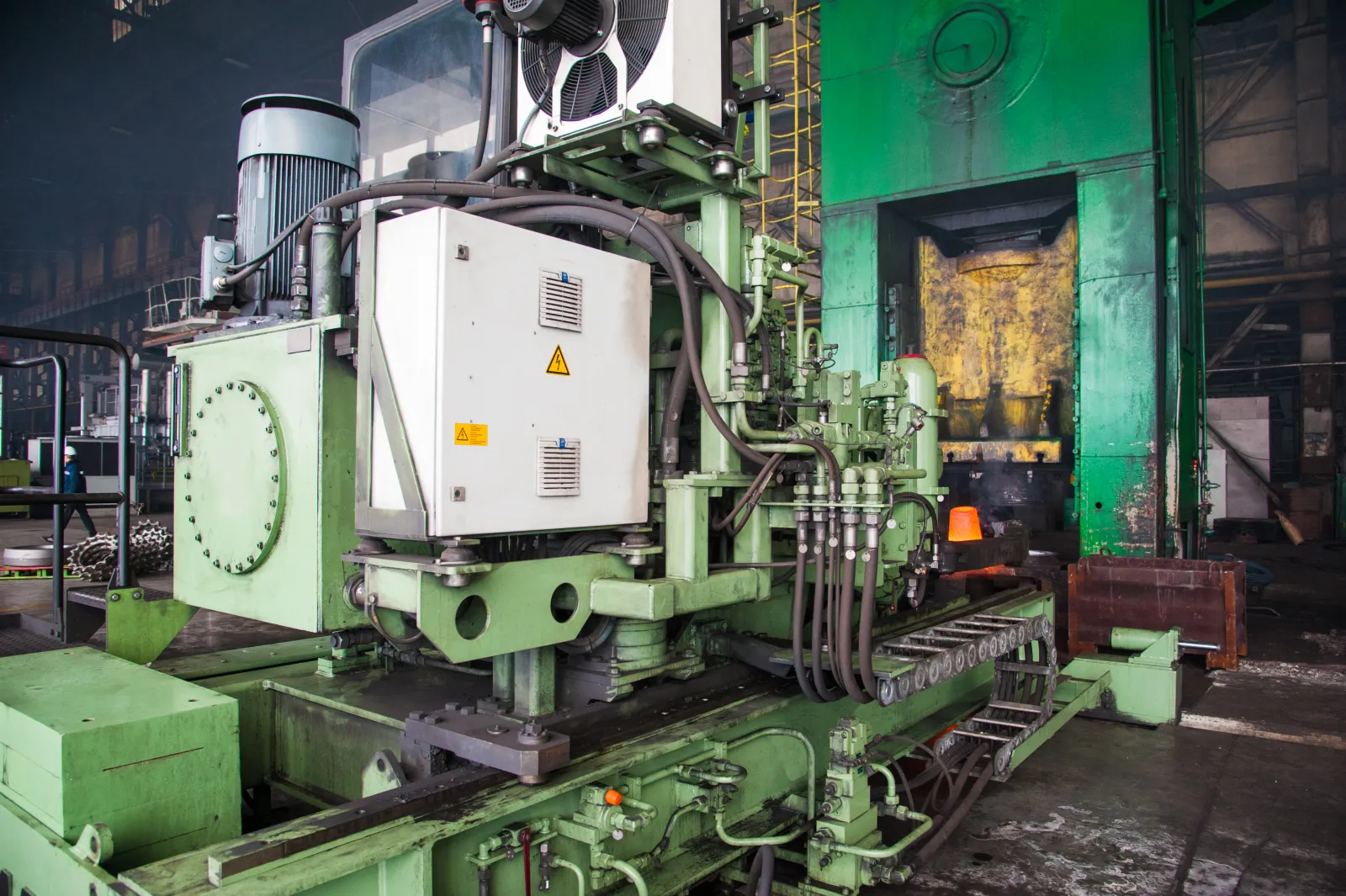
The commissioning report proves that a modernised machine has been tested after the modification and released for production. It contains the scope of changes, the electrical tests according to EN 60204-1, the signal test, the commissioning of the drives, the function and safety tests, open points and the release with signature. Together with program versions and diagrams it is the basis for every later service call.

Selected customers
What is a commissioning report and why do you need it after a retrofit?
The commissioning report records what was changed on the machine, which tests were carried out afterwards, with which result and who released the machine. After a retrofit it matters for three reasons:
- Proof: it shows that electrical safety, functions and safety functions have been tested after the modification.
- Release: operator and modifier jointly record from when the machine produces again and what is still open.
- Service: at the next fault your maintenance team knows which version is installed and what has changed.
There is no regulation called commissioning report. The content follows from the tests that are required after the modification anyway and from what you need for release and service.
What belongs in the commissioning report?
You can adopt this structure as a template. It fits controller migrations, drive replacements and comprehensive retrofits; mark parts not affected by the modification as not applicable.
| Part | Content |
|---|---|
| Master data | machine, location, inventory number, order, date, participants from operator and modifier |
| Scope of changes | what was renewed, what remains unchanged, assessment of substantial modification with result |
| Initial state | backed-up old program version, parameters, photos of the control cabinet before the modification |
| Electrical tests | tests according to EN 60204-1 Section 18 for the modified parts, measured values and measuring instrument |
| Signal test | every input and output with designation, address, expected reaction, result, date and initials |
| Drives | parameter set, direction of rotation, end positions, homing, brake, limits for current and speed |
| Functions | operating modes, sequences, faults, restart after emergency stop and after power failure |
| Safety functions | every safety function with required performance level, test, result, signature of the safety program |
| Interfaces | communication with panel, control system, MES and neighbouring machines, every connection tested |
| Trial run | production with good parts, cycle time, anomalies |
| Open points | item, responsible person, deadline, whether it blocks the release |
| Handover and release | new program version, backups, diagrams, instruction, signatures of operator and modifier |
For every test, record who carried it out when and with which result. Measured values belong in the report with measuring instrument and unit. A bare “OK” is not enough.
Which electrical tests are required after the modification?
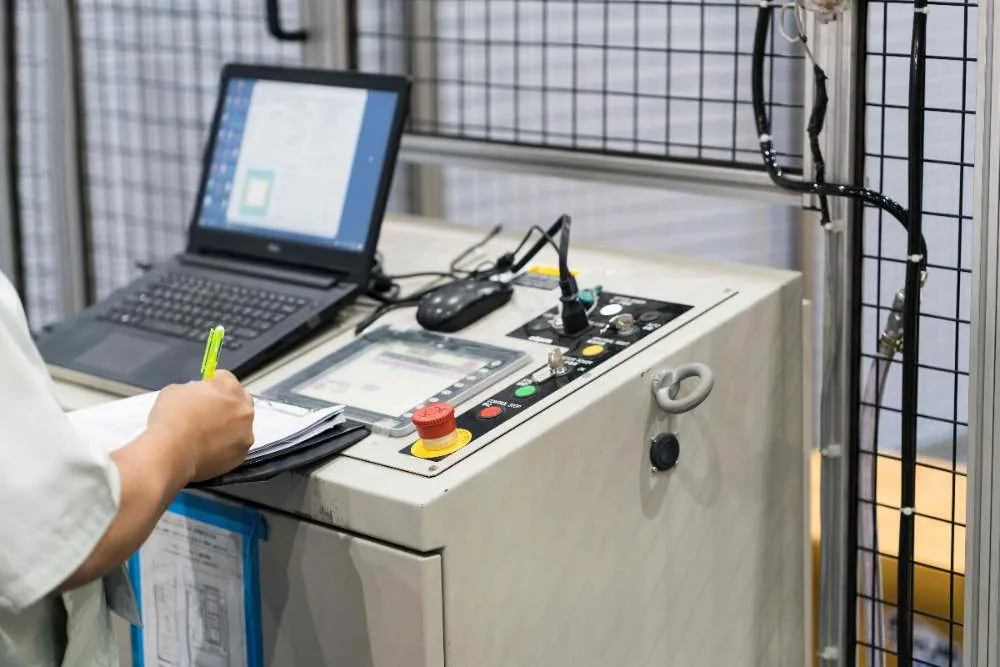
After a modification, test the modified parts of the electrical equipment according to Section 18 of EN 60204-1 and check whether the change affects other parts. Depending on the scope, this includes:
- continuity of the protective bonding circuit
- conditions for protection by automatic disconnection of supply
- insulation resistance
- voltage test
- protection against residual voltages
- functional tests
Limit values, measuring methods and a report template are given in the article Test report according to EN 60204-1. If a new control cabinet is built in our hall, we test it there in advance. At the machine, the tests on the new connections and on the parts connected on site remain.
Does the report count as an inspection under the German Industrial Safety Regulation?
After a modification subject to inspection, the operator must have the machine inspected by a person qualified to carry out inspections before it is used again (Section 14 (3) BetrSichV). If the commissioning report is to document this inspection, it must contain at least the type of inspection, the scope, the result and the name and signature of the qualified person. It is kept at least until the next inspection.
How do you document the signal test?
In the signal test every input and output on the machine is triggered and we check whether controller and panel react correctly. After a controller migration it is mandatory because addresses, wiring or modules have changed. One line per signal is enough:
| Designation | Old address | New address | Signal | Expected reaction | Result | Date, initials |
|---|---|---|---|---|---|---|
| -B12 | E 4.3 | %I12.3 | Slide front end position | message on panel, step 5 enabled | OK | example |
| -Q7 | A 2.0 | %Q8.0 | Clamping valve | cylinder extends, end position reached | end positions swapped, corrected | example |
Check analogue signals at at least two points of the measuring range, for example at 4 and 20 mA, and note the displayed value. How long the signal test takes and how downtime can be saved is calculated in the article PLC migration to S7-1500.
What belongs to the drives?
- parameter set backed up and entered in the report with version
- direction of rotation, end positions and homing checked
- holding brake: release and engagement checked
- limits for current, speed and torque set and documented
- safe drive functions such as STO tested as a safety function
How are the safety functions documented in the report?
Every safety function affected by the modification is tested individually and recorded with its result: emergency stop, guard doors and interlocks, light curtains, two-hand controls, operating mode selection and safe drive functions. In addition to the analysis, EN ISO 13849 requires at least a functional test of every safety function. Validation procedures are given in EN ISO 13849-2.
| Entry | Example |
|---|---|
| Safety function | opening the guard door stops all hazardous movements |
| Required performance level | from the risk assessment, for example PL d |
| Test | open the door during movement, check stop and stop category, restart only after acknowledgement |
| Result | movement stops, no automatic restart |
| Evidence | signature of the safety program, date, name |
If a safety program is recompiled for a new safety controller, its signature changes. It must then be validated and accepted again. If the response time of the safety chain changes, we measure the overrun time at electro-sensitive protective equipment and check whether the safety distance still fits.
If safety functions have so far only been implemented in the standard program or in hard-wired relays, a risk assessment and a design according to EN ISO 13849-1 are needed before the modification.
How does the release work and what happens to open points?
The machine goes into production when all tests have been passed or the open points do not block the release. Therefore classify every open point:
- Blocks the release: everything that concerns safety or part quality, for example a failed safety function.
- Does not block: convenience and rework, for example a message text on the panel or an update in the diagrams, each with a responsible person and deadline.
What belongs to the handover
- new program version of controller, panel and drives, backed up and with version
- old program version as a fallback until the release has been given
- circuit diagrams and I/O list in the as-built state
- assessment of substantial modification, in the case of a substantial modification declaration of conformity and operating instructions
- instruction of operators and maintenance staff in the changes
- signatures of operator and modifier with date
On request we take the report with backups and diagrams into the plant file of NIKLAS CARE. Program version and documentation are then ready for the next service call. More on the modification itself under machine retrofit.
Frequently asked questions about the commissioning report
Short answers to the questions that come up most often after a modification.
Is a commissioning report mandatory?
There is no regulation with this name. What is mandatory are the tests after the modification, for example according to EN 60204-1 and, in Germany, Section 14 (3) BetrSichV, and their records. The commissioning report combines this evidence with release and open points.
Who signs the commissioning report?
The modifier for the work and tests carried out, the operator for acceptance and release. If it also documents the inspection under the German Industrial Safety Regulation, the person qualified to carry out inspections signs as well.
Does every input and output really have to be tested?
After a controller migration yes, because addresses, modules or wiring have changed. For a pure drive replacement, test the signals affected by the replacement.
What is the difference between FAT and SAT?
The factory acceptance test (FAT) takes place before delivery, for example on the new control cabinet in the workshop. The site acceptance test (SAT) follows at the machine after installation. Whatever is tested in advance shortens the downtime.
How long must the report be kept?
If it counts as the record of the inspection under Section 14 BetrSichV, at least until the next inspection. For service it is worth keeping report, program versions and diagrams for as long as the machine is running.
Is there a template for the commissioning report?
You can adopt the structure in this article as a template. For our retrofits we prepare the complete report with signal test, tests and handover.
More technical articles
Retrofit Retrofit
Spare part discontinued
Controller, panel or drive discontinued: check the status, back up the current state, choose a bridging solution and plan the successor before a failure stops production. With a list of critical parts and a comparison of the options. Retrofit
PLC migration to S7-1500
Failure risk, data backup, I/O reserve, cycle time, program conversion, safety technology and signal test: how a PLC migration to S7-1500 or Beckhoff becomes plannable and what determines the effort.Plan commissioning after the modification
State the machine, scope of the modification and your downtime window. We will get back to you with an initial assessment of tests and process.
Simon Niklas
Mechanical engineer, M.Sc.
+49 941 56956720[email protected]
“Good engineering proves itself in day-to-day production. That is why we combine technical planning with a close understanding of process, operation and maintenance.”
Book a consultation