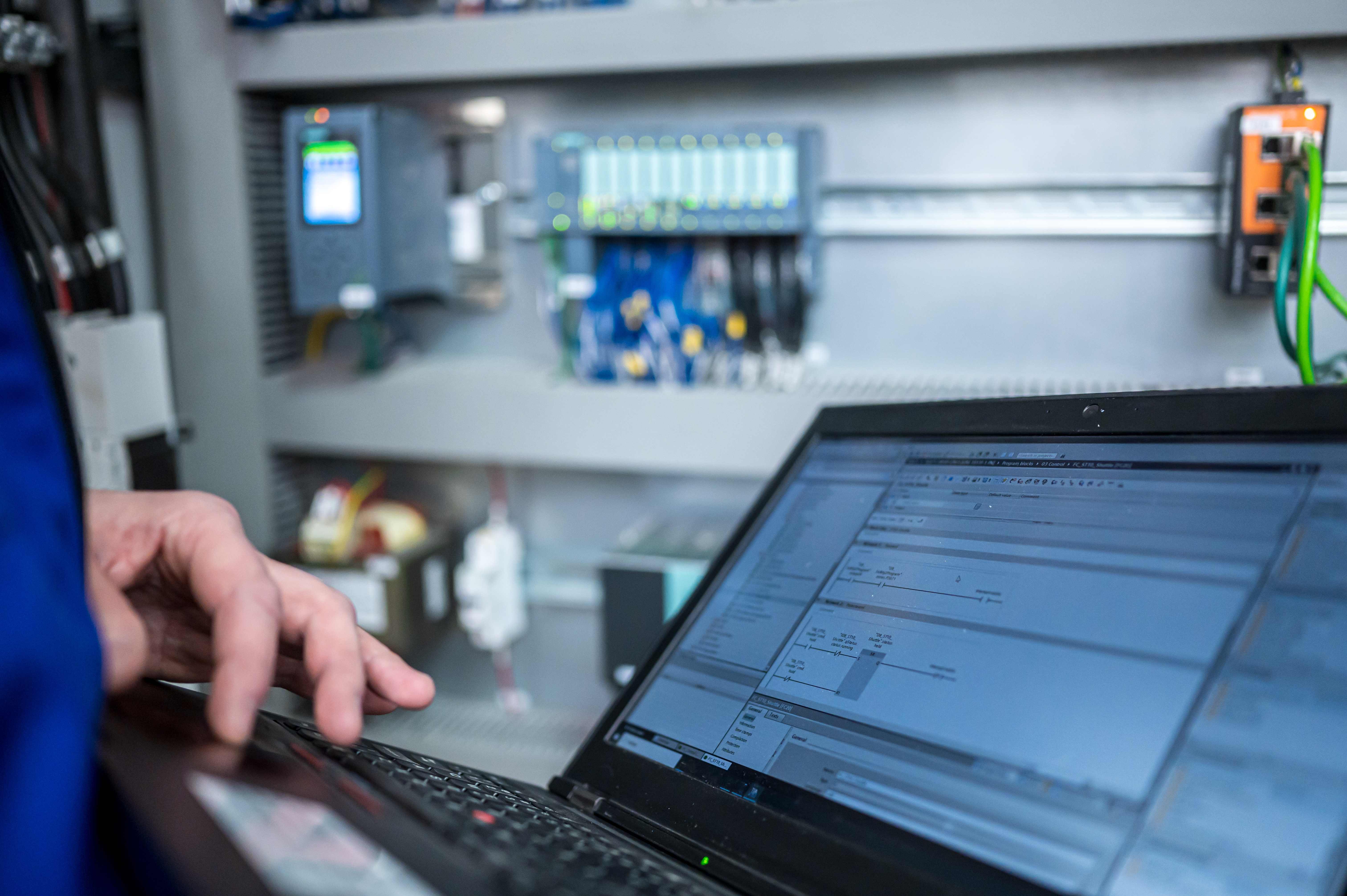
ENGINEERING · ROBOTS & PLCS
Robot & PLC programming for your production.
We program robots and PLCs for new and existing systems. Motion, machine sequences and operation work together – for shorter waits, clear diagnostics and a defined restart. We also support systems supplied by other integrators.
Selected customers








ROBOTS · PLCS · INTEGRATION
Program robots and machine control together.
From a single machine to a robot cell or linked production system: we develop robot programs and PLC logic for your process. States, permissions and handovers are coordinated across the control systems.
01
ROBOT PROGRAMMING
Motion and process paths
We set up tool and base coordinates, program gripping points and process paths, and adjust motion profiles. Waiting times, unnecessary travel and interaction with grippers and process tools are reviewed in detail.
02
PLC PROGRAMMING
Sequences and machine logic
We program step sequences, operating modes, interlocks and peripheral control. Sensors, actuators and stations use defined states; operation and diagnostics are matched to the actual machine sequence.
03
SYSTEM INTEGRATION
Clearly defined handovers
Robots, PLCs and adjacent stations exchange permissions, acknowledgements and result data through defined interfaces. We coordinate product changeovers, fault handling and restart across the control systems involved.
PROGRAMMING & COMMISSIONING
From robot paths to PLC sequence control.
We bring motion, control logic and operation together in a coherent machine sequence. We develop programs for new systems and extend or optimise existing functions. Scope, access and technical constraints are agreed before work starts.
01
Robots: tool and base coordinates, gripping points, process paths and motion profiles
02
PLCs: step sequences, operating modes, interlocks, sensor inputs and actuator control
03
Interfaces: robot–PLC handshakes, station handovers, recipes and variant selection
04
Operation and diagnostics: HMI messages, fault handling and defined restart steps
OPERATION & DEVELOPMENT
Programs your team can work with.
Introduce new products, reduce waiting times or locate faults more quickly: we adapt robot and PLC programs to your system. Program structure, operation and documentation are part of the work, so production and maintenance can follow the changes.
01
PROGRAM STRUCTURE
Clear states and functions
Readable robot programs and structured PLC functions with consistent names, data and comments make fault finding and later extensions easier.
02
PRODUCT CHANGEOVERS
Extend product variants
Gripping points, process paths, recipes and PLC sequences are coordinated for new parts. We agree any required changes to tools, fixtures or peripherals with you.
03
DIAGNOSTICS & RESTART
Locate faults more quickly
Messages identify the affected area and unmet conditions. Robot position, part status and PLC step are considered together, making the next operator action clear.
04
HANDOVER & SUPPORT
Backed-up program versions
Robot and PLC programs, parameters and agreed HMI versions are backed up and documented. Tests and open points are recorded. We remain available for modifications and fault analysis.
IMPLEMENTATION
Project stages and technical handover.
For SAR Electronic GmbH, we developed software for a complex robotic application and commissioned the system on site at the end customer.
-
INITIAL ASSESSMENT
Establish the system and objective
We review robots, PLCs, operator interfaces, existing programs and connections. Required functions, access and the planned intervention in production are agreed with you.
-
PROGRAMMING
Implement motion and sequence logic
Robot paths and PLC step sequences are coordinated with peripherals, station handovers and operation. Variants, messages and restart are included in the agreed programming scope.
-
TESTING & OPTIMISATION
Test sequences and fault scenarios
We test signals, operating modes, handovers and typical faults under agreed conditions. Motion, waiting times and restart are checked against the real process; results and open points are recorded.
-
HANDOVER
Hand over programs and changes
Backups, parameters, version records and agreed documentation are handed over. We clarify required access and licences, along with the next steps for production and maintenance.
ROBOT & PLC PROGRAMMING QUESTIONS
Clarify programming, cycle time and restart.
Robot programming controls motion and process paths. PLC programming controls machine states, step sequences and peripherals. We provide either service separately or combine them, defining the scope around your system.
- We develop or modify machine sequence control: step sequences, operating modes, interlocks, sensor inputs and control of actuators and peripherals.
- The scope can include station interfaces, recipes, HMI operating functions and diagnostic messages. The existing controller, program access and documentation determine what can be implemented.
- Yes. PLC programming is a standalone service, including single machines and linked stations without robots.
- We review the existing controller and machine process, then implement the agreed functions. For modernisation projects, we agree any necessary electrical or operator-interface changes with you.
- We program motion, gripping points and process paths, set up tool and base coordinates, and adjust motion profiles.
- For new and existing systems, the agreed scope can also include variant selection, fault handling and coordination with the PLC, gripper and process tool.
- We examine the complete sequence: robot motion, PLC steps, waiting conditions and machine and tool times.
- Changes are checked on the system for movement clearance, calibration and required process quality. The achievable reduction depends on the actual bottlenecks.
- We review robot position, part and tool status, and the current PLC step. Permissions, withdrawal paths and messages are coordinated around the machine sequence.
- Typical fault scenarios are tested on the system and operator steps are documented. Existing safety functions and approval procedures remain binding constraints; program tests do not replace separate safety validation.
- We check payload, reach, grippers, fixtures and process tools against the new parts.
- Robot paths, PLC sequences, recipes and variant selection are adapted together. Drawings or sample parts and the target cycle time support the assessment.
- Yes. We support, program and develop existing systems supplied by other integrators.
- We review robot and PLC programs, controllers, interfaces and available software access. If documentation is missing, we first establish what needs recording and which functions must be retained or changed.
- The agreed handover includes backed-up programs and parameters, version records and documentation of changes and tests.
- Depending on the system, it may also include tool and base data, interface signals, recipes, HMI versions and restart instructions. Open points and required software licences are recorded explicitly.
DISCUSS YOUR PROJECT WITH US
Have your robot or PLC programmed.
Describe your system and the function or change you need. Details of the robot, PLC, operator interface, existing programs and fault messages help us assess the work. We will clarify any missing information with you.